

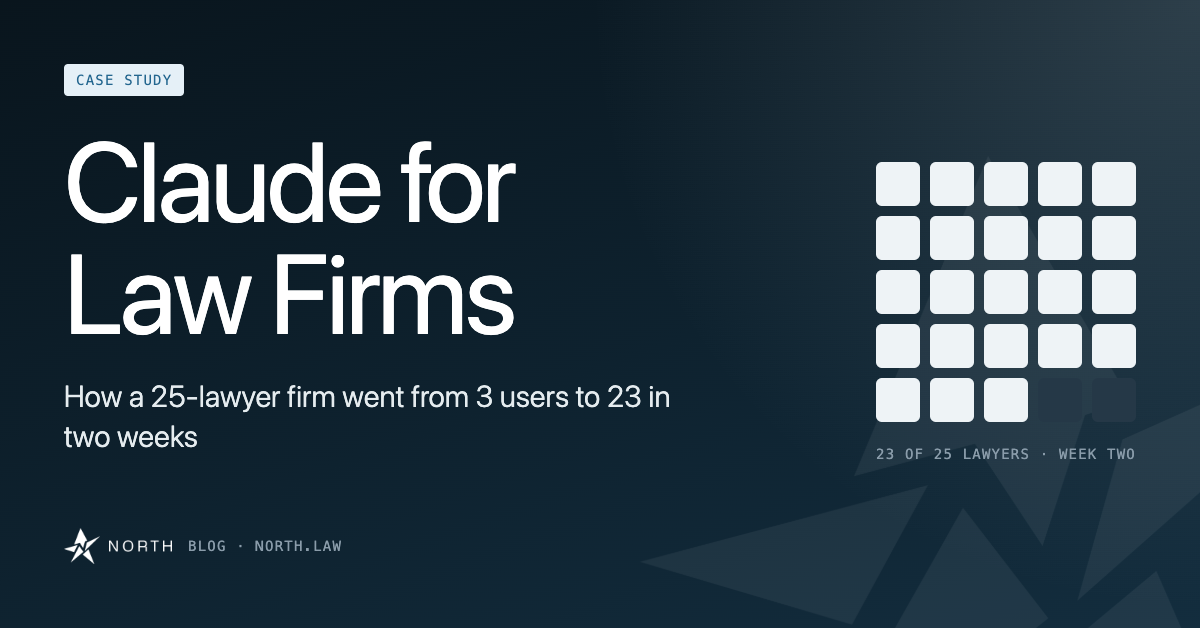
Three weeks ago, North onboarded a 25-person law firm in New York.
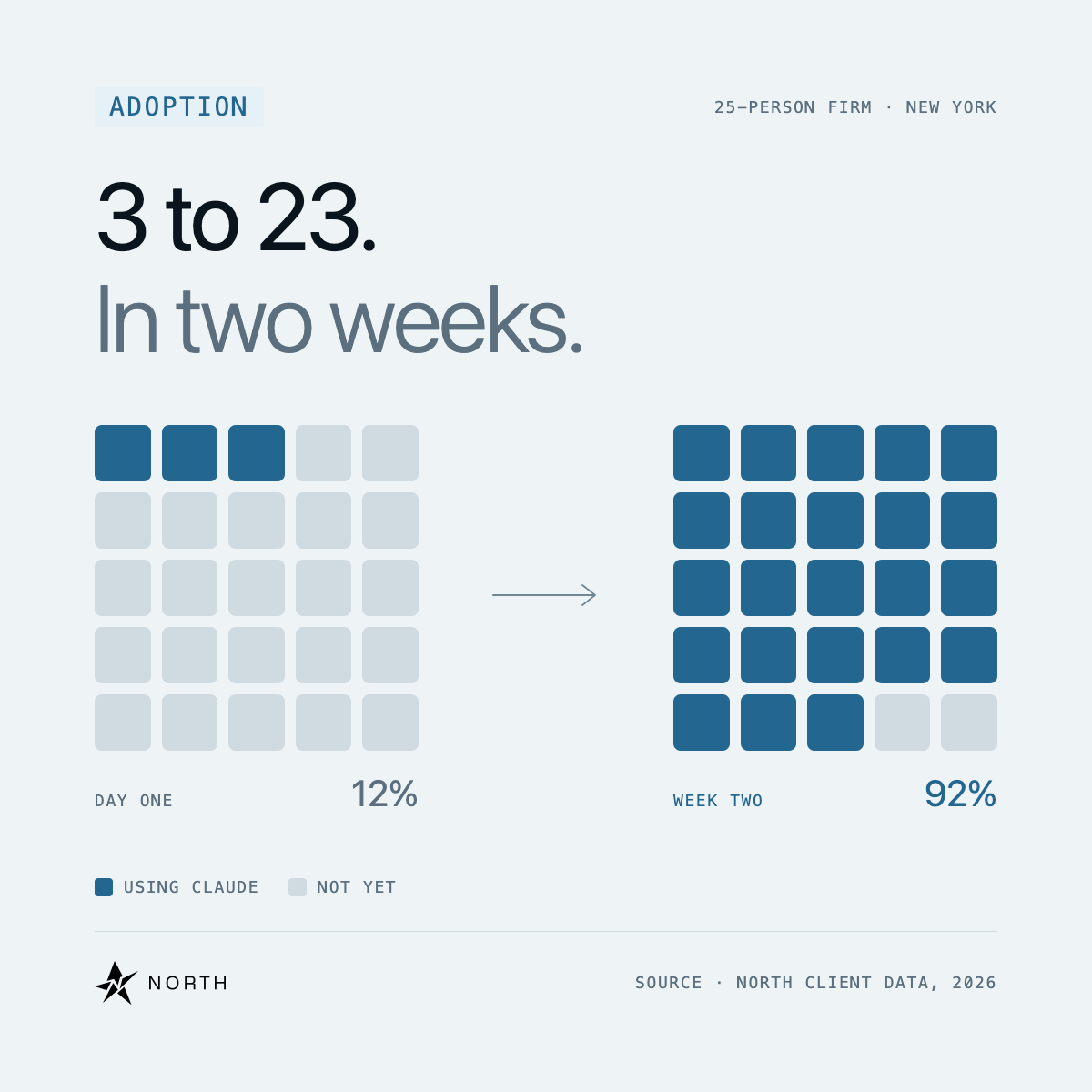
On day one, 3 of their lawyers used Claude. Two weeks later, 23 did.
Same model every other firm has access to. Same licenses. A completely different outcome. This is the story of what changed, and what Claude implementation for law firms actually looks like when it's done right.
The pattern we see everywhere
We talk to law firms every week. The story is almost always the same.
The firm buys AI licenses. Someone sends a kickoff email. Nobody gets trained.
A few months later, maybe 1 lawyer in 5 actually opens the tool. The rest go back to the way they've always worked. Leadership quietly wonders whether AI was overhyped.
It wasn't. The rollout was underbuilt.
The firm
- Size: 25 people
- Location: New York
- Practice: [practice areas, e.g. M&A, corporate, real estate]
- Starting point: 3 of 25 lawyers using Claude on day one
- Goal: get AI into the daily work of every lawyer, on real matters, not demos
Like most mid-sized firms, they had access to the technology. What they didn't have was a path from access to habit.
What changed
Three things. None of them were the model.
1. Claude learned the firm
We connected Claude to the firm's own documents, emails and matters. Then we added North's intelligence layer, which maps every data point to every other one.
The result: the very first answer a lawyer got was already useful. Not generic. Not a demo. An answer grounded in their own deals.
That first useful answer is what brings someone back the next morning.
2. A Legal Engineer sat at their desks
A North Forward Deployed Legal Engineer spent a full week in the firm's office. Desk by desk. On their real deals.
No slide decks. No generic training videos. Just lawyers learning on the work already in front of them.
The support didn't end there. Our engineer comes back every month, trains the team remotely week after week, and builds custom tools for the way this firm works.
3. We watched usage every week
Adoption isn't a launch. It's a habit, and habits break quietly.
So we track usage weekly. When someone goes quiet, we call them before they give up.
The results

The industry norm we see is roughly 1 in 5 after a few months. This firm passed 9 in 10 in two weeks.
The skeptic
One partner was openly skeptical on day one. He'd heard the promises before.
By week two, he had hit his usage cap.
The model was never the bottleneck
Every firm can buy the same model. That's exactly why the model isn't the advantage.
The advantage is the implementation. Claude for lawyers only works when it knows the firm's work, when people learn it on real matters, and when someone notices before usage fades.
If your firm bought AI licenses this year, ask yourself three questions:
- Does the tool know your documents, emails and matters, or is it starting from zero every time?
- Did your lawyers learn it on their own deals, or from a kickoff email?
- Do you know who opened it this week, and who quietly stopped?
If the answers make you uneasy, the problem isn't AI. It's the habit.
See it live
North brings Claude into law firms the way it was meant to be used: connected to your work, taught at your desk, and supported until it sticks.
If you run a firm and want to see what this looks like on your own matters, book a walkthrough.