

Claude for Legal is Anthropic's dedicated offering for law firms and in-house teams: practice-area plugins, connectors to the legal software firms already use, and Claude working inside Word and Outlook. It's available on paid Claude plans. Used as shipped, it's a strong assistant. Configured for your firm, it becomes part of how the work gets done.
In May, Anthropic went from powering other legal AI tools to building for lawyers directly. Law firms have been asking what it means for them ever since. Here's what it is, what it actually does, and what it takes to make it work across a firm.
What is Claude for Legal?
Claude for Legal launched on May 12, 2026, as 12 practice-area plugins and more than 20 connectors linking Claude to legal software. It built on a single legal plugin Anthropic released in February for Claude Cowork, its agentic desktop workspace.
The demand was already there. After that first plugin, legal became the top power-user function in Cowork, with more than three times the usage of any other job. Over 20,000 people registered for Anthropic's April webinar on how legal teams use Claude.
Claude for Legal isn't a new model. It's a layer of plugins, skills and connectors on top of Claude, and Anthropic has published the plugins openly on GitHub so firms can inspect and adapt them.

What's included?
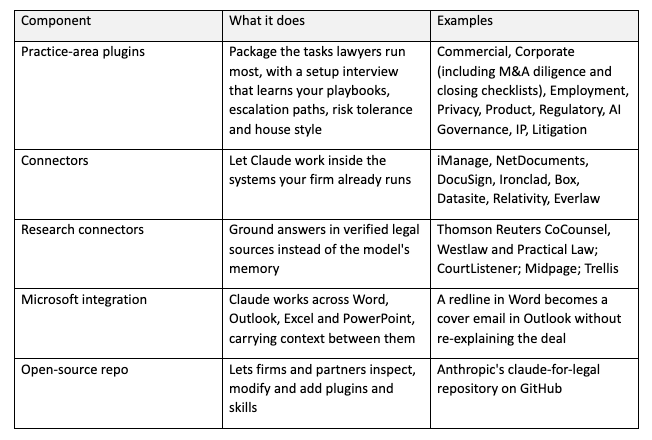
For a transactional firm, the Corporate plugin and the document-system connectors matter most. Diligence, closing checklists and contract review are the work that eats associate hours.
How are law firms actually using it?
The firms getting real value use Claude for Legal on live matters, not side experiments. When Freshfields rolled Claude out to thousands of lawyers across 33 offices, usage grew about 500% in six weeks. Quinn Emanuel, Holland & Knight and others announced live use alongside the launch.
At a transactional firm, the high-value uses look like this:
- NDA triage. Sort inbound NDAs against the firm's playbook so lawyer time goes only to the ones that need it.
- Contract first-pass review. Flag deviations and draft redlines in Word, in house style.
- Diligence. Pull documents from the data room and turn them into a grid: one row per contract, one column per question, every answer cited.
- Closing. Keep the checklist current and assemble signature packets as documents come in.
- Matter follow-up. Turn a redline in Word into a client email in Outlook, without re-explaining the deal.
In every case, the lawyer reviews the output and makes the call. Claude drafts and organizes. Judgment stays with the lawyer.
Is Claude for Legal safe for client data?
It can be, if the firm uses the right plan and sets it up properly. On business plans and the API, Anthropic doesn't use customer data to train its models unless a firm opts into its Development Partner Program. The bigger risk is lawyers pasting client documents into personal accounts, which run under consumer terms.
The connector design also helps on accuracy. Claude can draw from live, verified sources like Westlaw, CourtListener and your document system, rather than answering from memory. That's Anthropic's main answer to hallucinated citations, which have already led to court sanctions.
Three things to settle before rollout:
- Plan and admin controls. Firm-managed accounts only, with an admin who enables connectors.
- Permissions. Connectors should respect matter access and ethical walls.
- Review policy. Cited outputs, verified by a lawyer, before anything leaves the firm. ABA Formal Opinion 512 (July 2024) makes reviewing AI output part of a lawyer's ethical duties.
Why doesn't it work out of the box?
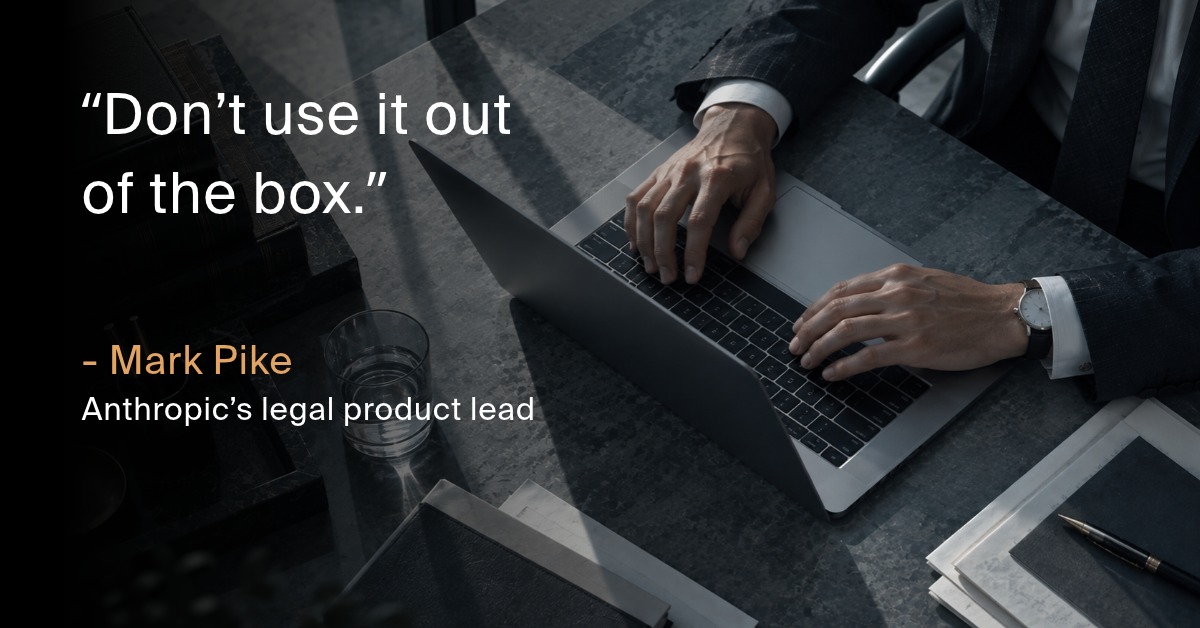
Because a legal practice isn't generic. Anthropic's own legal product lead, Mark Pike, used to tell customers "don't use it out of the box", and said it works best customized with the firm's own playbooks. The new setup interview is a strong start. It still can't do three things on its own:
- Connect your institutional knowledge. Precedents, prior deals, email threads and meeting notes live in different systems.
- Build your workflows. A closing checklist at your firm has its own steps, owners and deadlines.
- Change habits. In our experience, licenses get bought and a few associates experiment. Partners rarely start, and usage fades by week three.
That gap between access and daily use is where most rollouts stall.
What does a firm-wide rollout take?
Five steps separate a firm that bought Claude for Legal from a firm that runs on it:
- Map the work. Pick two high-volume, rules-based workflows, such as NDA triage and closing checklists. Wins in week one build momentum.
- Connect the systems. Link your document system, email and matters under existing permissions, so Claude knows the firm, not just the law.
- Configure for your practice. Load playbooks, precedents, fallback positions and house style into the plugins and custom skills.
- Start with partners. Associates follow what partners actually do. Show partners cited output on their own matters.
- Measure use, not licenses. Track active users by role and matters touched each week, then fix friction as it shows up.
Do you need an implementation partner?
Not always. A solo practitioner or a firm with an in-house innovation team can install the plugins and configure them on its own.
Most 15–30 person transactional firms have neither the time nor the team. Partners bill too many hours to run a pilot, and there's no IT department to own it. That's where an implementation partner earns its keep: someone on-site who connects the systems, builds the workflows and stays until lawyers use Claude every day.
That's what North does. We engineer Claude into your firm with North OS and put legal engineers on-site through North Deploy. Learn more about Claude implementation for law firms.
FAQ
What is Claude for Legal? Anthropic's offering for law firms and legal teams, launched May 12, 2026. It includes 12 practice-area plugins, 20+ connectors to legal software, and Claude working across Word, Outlook, Excel and PowerPoint.
How much does Claude for Legal cost? Anthropic says the connectors and practice-area plugins are available to all paid Claude customers. Cost depends on the Claude plan your firm chooses.
Is Claude for Legal safe for confidential client information? On business plans, Anthropic doesn't train on your data. Add connectors that respect matter permissions and a lawyer's review of every output, and the main remaining risk is personal accounts.
How does Claude for Legal compare to Harvey? They're increasingly connected. Harvey builds on Claude models, and it has its own connector inside Claude for Legal. The difference is approach: Harvey is a dedicated legal AI platform, while Claude for Legal brings legal tools into Claude itself.
Ready to make Claude for Legal work across your firm? Book a 30-minute call to see it on your own matters.
Sources
- Anthropic Goes All-In on Legal, LawSites, May 12, 2026
- AL Interview: Mark Pike, Anthropic Associate General Counsel, Artificial Lawyer, May 12, 2026
- Big Law goes all in on AI with new Anthropic release, Fortune, May 12, 2026
- Anthropic expands Claude's AI tools for law firms, Reuters, May 12, 2026
- Does Anthropic act as a data processor or controller?, Anthropic Privacy Center
- ABA Issues Comprehensive Formal Ethics Opinion on Lawyers' Use of Generative AI, Frankfurt Kurnit, on ABA Formal Opinion 512 (July 29, 2024)