
A firm buys enterprise licenses, runs a lunch-and-learn, sends a follow-up email with a few prompt tips, and waits. Three months later, the usage dashboard tells a different story: a handful of associates use the tool constantly, most people logged in once and never came back, and several partners have never opened it at all. The firm didn't fail to deploy AI. It failed to manage the change that using AI actually requires.
Deployment is procurement, configuration, and a training session. What happens after that is a different kind of work entirely, the work of getting a lawyer to choose the AI tool over the familiar way of drafting an NDA or building a closing checklist on an ordinary Tuesday. Buying the software doesn't answer that question. Change management does.
Why lawyers wave off the tools they've already been given
Lawyers aren't resisting AI out of stubbornness. Billable-hour pressure makes experimentation expensive: learning a new tool on a live matter feels riskier than doing the work the familiar way, especially with a real deadline and a client watching. Professional liability adds a second layer.
A lawyer who has spent a career serving as the last line of defense against a mistake in a contract or a demand letter isn't going to hand that responsibility to a tool without a reason to trust its output, and public cases of AI-generated fabricated citations have given every lawyer who's heard about them a reason to be skeptical of confident-sounding answers by default.
A login and a single training session don't resolve any of that. They solve availability and initial capability, not the habit that determines whether AI actually touches a matter or sits untouched in a browser tab. What closes that gap is a firm convincing a skeptical partner that using the tool is expected, choosing the right workflow to start with, and turning one enthusiastic associate's habit into the norm for an entire practice group. That's change management, and it has to run alongside training, not after it.
Adoption starts with leadership actually using the tool
Firm leaders often assume that endorsing AI from the podium is enough. It isn't, and the gap between endorsement and visible use is wider than most partners realize. In a study of legal AI adoption conducted in the late summer of 2025 by DISCO with Ari Kaplan Advisors, surveying 112 legal professionals with 32 in-depth follow-up interviews, only 43% of law firm participants said they felt pressure from their own leadership to adopt AI, compared to 64% of respondents inside corporate legal departments. Law firms, in other words, are less likely than their in-house counterparts to have leadership actually pushing adoption, even as the tools sit on everyone's desk.
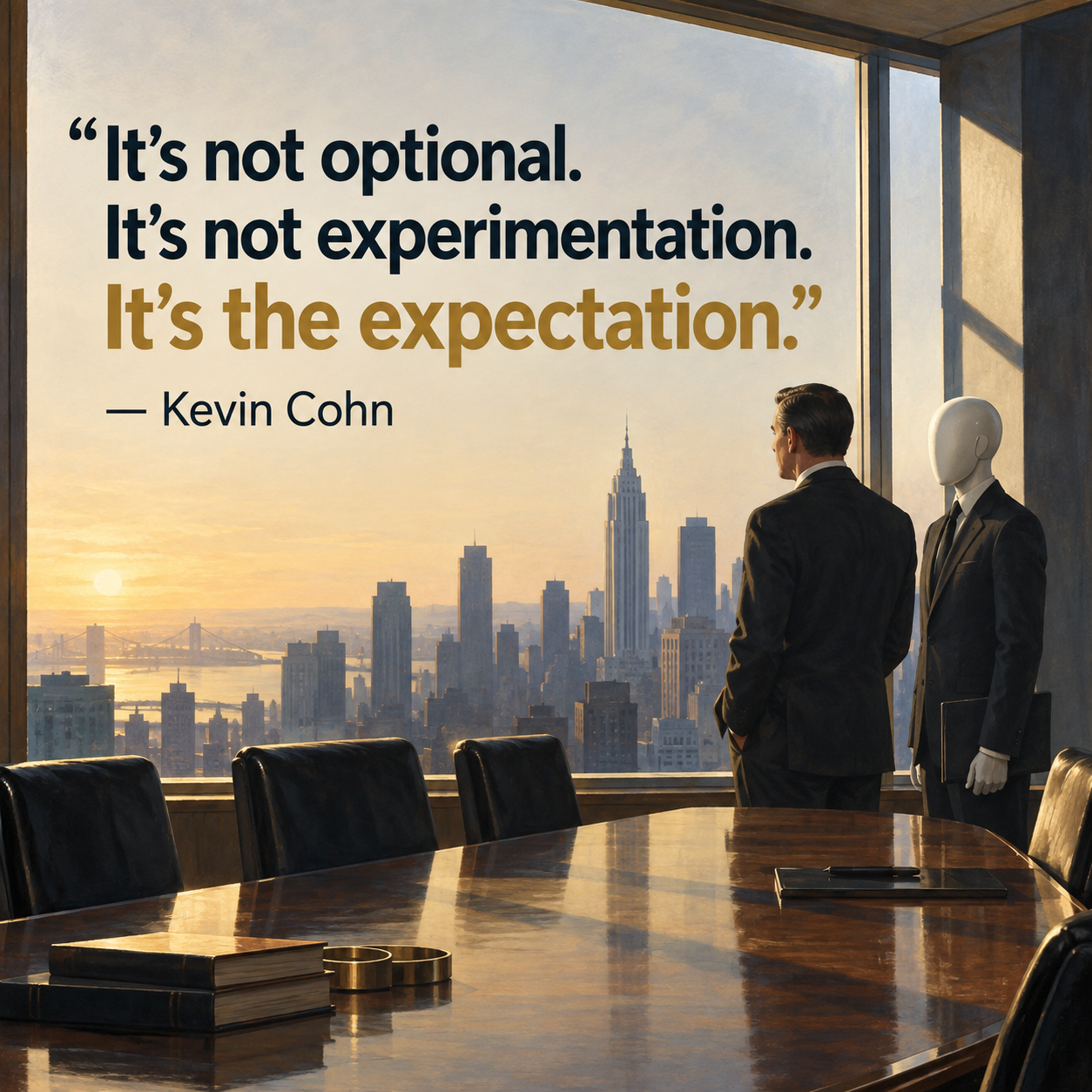
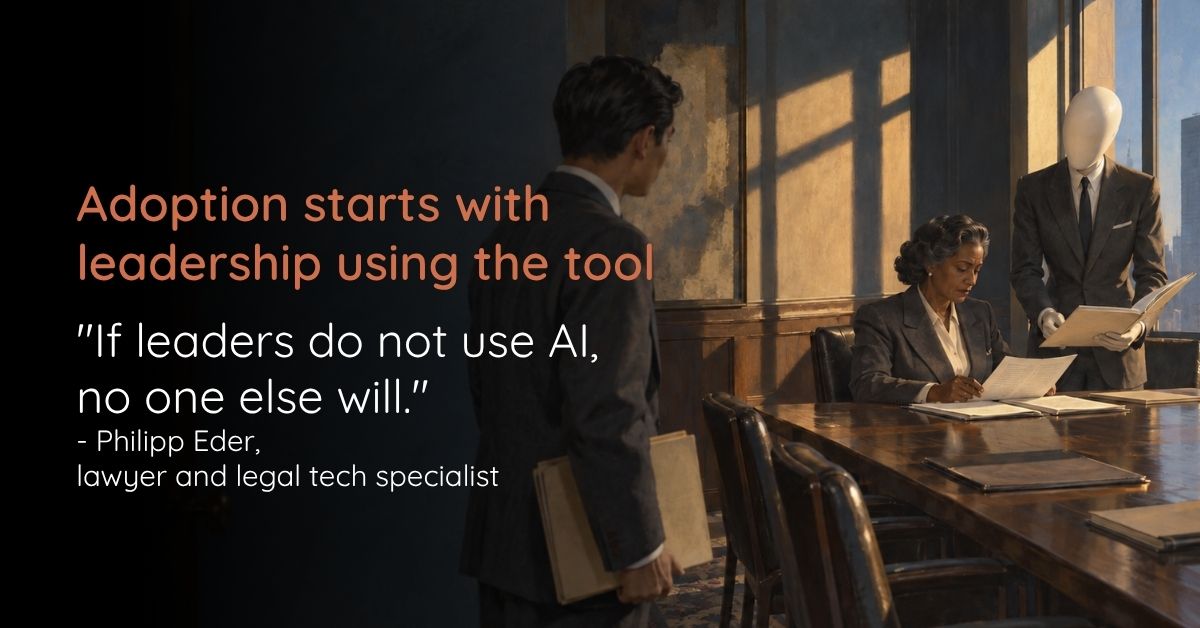
Legaltech leaders speaking about Wolters Kluwer's 2026 Future Ready Lawyer research made the same point more bluntly. Philipp Eder put it this way: "If leaders do not use AI, no one else will." Kevin Cohn, general manager at Brightflag, argued that leadership has to say plainly that adoption "is not optional. It's not experimentation. It's the expectation." A managing partner who cites AI-assisted research in a partners' meeting, or asks a junior associate to run a first-pass contract review through the firm's tool before a call, does more to move adoption than any all-hands presentation. Lawyers calibrate their own risk tolerance against what the people above them are visibly willing to do.
What makes a good pilot workflow
Firms that roll AI out everywhere at once tend to get patchy results, because different workflows have very different tolerances for the tool's current limitations. The better approach is to pick one workflow deliberately, against a short set of criteria instead of whatever looked impressive in a demo.
A good starting workflow is high in volume, so there's enough repetition to build a real habit fast. It has a defined output a supervising lawyer can check quickly, the way a senior associate reviews a first-year's markup. And it's a task people already find tedious or already disagree about how to do consistently, because that friction makes a better way welcome instead of resented. NDA review, lease abstraction, first-pass due diligence document review, and demand letter drafting all fit that profile at most firms. A high-stakes, low-volume task like drafting a novel deal structure doesn't, no matter how well the tool performs on it in a sales pitch.
Tara Daisy, now Managing Director of Legal at Box, after leaving the law firm world, frames the starting question simply: "What are your end goals?" Firms that skip that question tend to pilot AI on whatever workflow a vendor demoed well rather than the workflow the firm actually needs fixed.
Recruit champions who spread the habit peer to peer
Naming a partner "AI champion" and adding it to their title doesn't create the behavior a champion is supposed to produce. What works is a distribution mechanism. Jamie LaMorgese, who directs enterprise applications at Holland & Hart, gives a small group of well-regarded, self-described "technology nerd" attorneys two weeks of early access before any wider rollout. "They like the early access, and they talk about the tool they have with other attorneys in the firm," LaMorgese explains. "It builds a little bit of excitement." The early group also surfaces integration problems while the audience is small enough that fixing them doesn't embarrass the firm in front of everyone.
That works because the persuasion comes from a peer, not from IT or a memo from the managing partner. An associate is more likely to try a tool because a respected colleague in the same practice group vouches for it than because a policy says to. Recruiting three or four of those people deliberately, in the practice group tied to the pilot workflow, does more for adoption than a firm-wide announcement ever will.
Build the feedback loop before you need it
A pilot that launches without a way to collect what's going wrong will quietly fail even if the tool itself works. Lawyers who hit a bad output, an awkward prompt, or a workflow step the tool doesn't handle well need somewhere immediate to say so, or they'll just stop using it and never mention why. Short, regular check-ins and a standing channel for flagging friction do more than a quarterly satisfaction survey, because the fixes happen while the workflow is still fresh in someone's mind.
North's forward deployed engineers sit inside that loop directly, working the pilot workflow against a firm's actual open matters alongside the lawyers using it, and turning what they learn into a reusable, governed skill inside North Deploy rather than a training memo that goes stale the first time a matter doesn't fit the pattern it was built for.
The metric that actually shows whether it worked

License counts and login totals say almost nothing about whether AI has become part of how work actually gets done. A better signal is weekly active use inside the workflow the firm chose to pilot. LaMorgese's team at Holland & Hart treats 70% weekly active users during a pilot, a meaningfully higher bar than typical usage across the broader population of lawyers, as the line between real adoption and what he calls "purchasing shelfware."
Wolters Kluwer's Future Ready Lawyer survey, fielded in August 2025 among 810 legal professionals across the United States, China, and nine European countries, found that 92% of respondents already use at least one AI tool in their daily workflow, yet only 61% expressed growing confidence in their organization's ability to adapt its actual workflows, service offerings, and pricing models to match. Individual use has outrun organizational readiness. That's the gap a firm should be watching, not the number of seats it purchased.
Putting this in order
Get the managing partner or practice group leader using the tool on a real matter before asking anyone else to. Pick one workflow using volume, checkability, and existing frustration as the filter, not vendor enthusiasm. Recruit a small group of respected early users in that practice group so the case for the tool comes from a colleague instead of a policy. Build a standing feedback channel before the pilot launches, not after the complaints start. And track weekly active use inside that specific workflow, not total licenses, as the measure of whether any of it worked.
None of that happens automatically once the software is purchased. It's a sequence of deliberate choices, the same sequence North Deploy is built to run: pairing a firm's leadership and its first pilot workflow with the firm-specific skills library and the forward deployed engineers who keep the workflow current as real matters test it. If a firm has already bought the tools and is watching the usage numbers stall, that's the conversation worth having next.
Sources: DISCO Generative AI Adoption Study, conducted with Ari Kaplan Advisors (fieldwork late summer 2025); Wolters Kluwer 2026 Future Ready Lawyer Survey Report (fieldwork August 2025); Wolters Kluwer, "A considerable 61% of respondents..." press release (March 2026); Wolters Kluwer Expert Insights, "Legaltech leaders stress change management, human assets as keys to effective AI scaling" (May 2026); Thomson Reuters Institute, "ILTACON 2026: Does it make the boat faster? How legal teams are finding AI implementation success" (August 2026).