

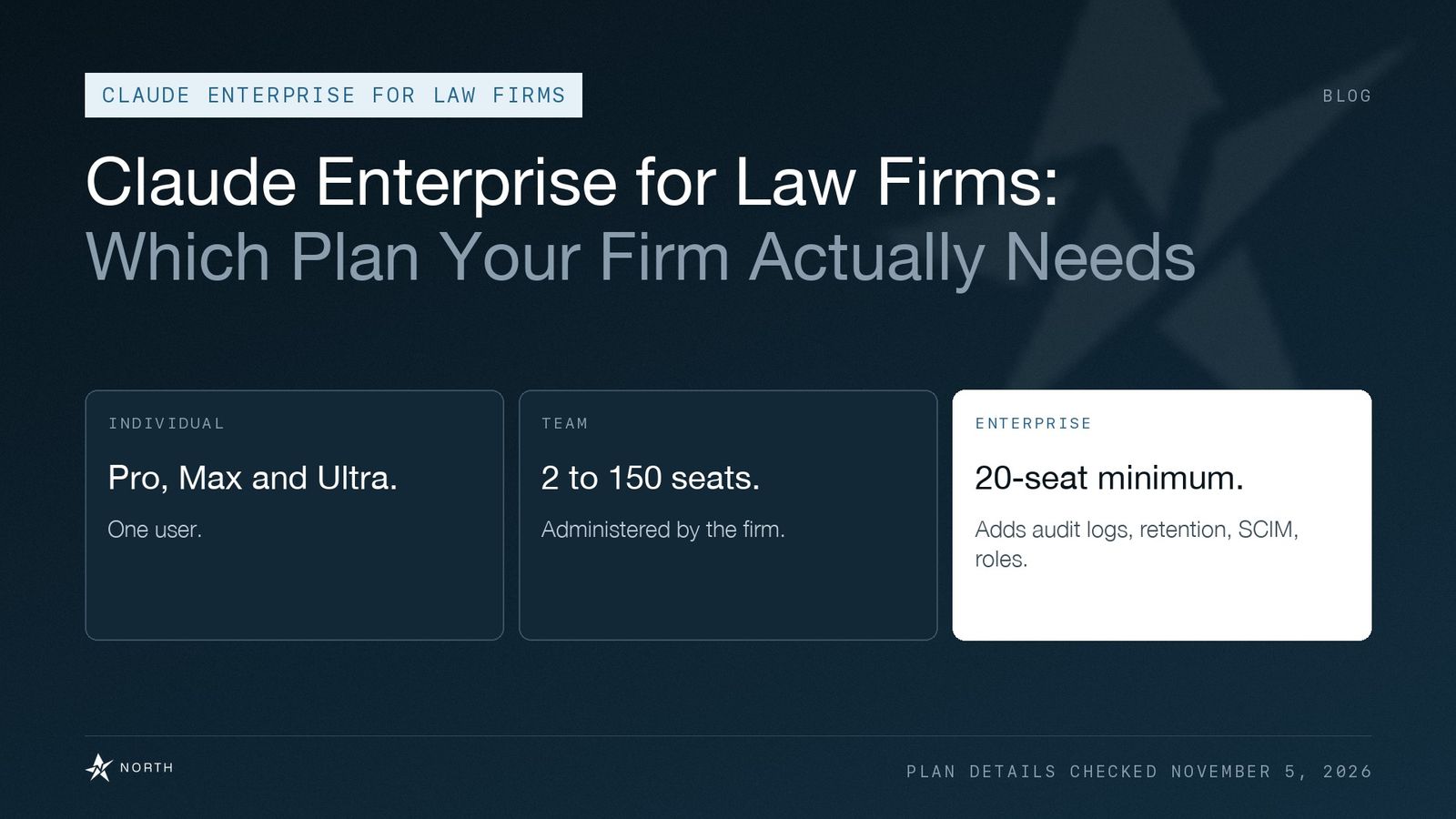
Start the plan decision with a headcount that includes everyone. Every lawyer, paralegal, legal assistant, and operations person who uses Claude takes a seat, and seat count decides which plans are open to your firm before any feature does. Anthropic's pricing page sets a 20-seat minimum for Claude Enterprise, while Claude Team covers 2 to 150 seats. For a firm that wants governed AI, the plan decides which controls exist at all.
Our view on Claude Enterprise for law firms: below 20 seats, Team is the plan. Above 150 seats, Enterprise is the only organizational option. Between those lines, the call depends on five controls only Enterprise includes (audit logs, a Compliance API, custom data retention, SCIM provisioning, and role-based access) and on what your clients and IT lead will ask you to prove.
Below, we lay out what each plan includes as of November 5, 2026, how seat count maps to plan, and where the October legal artifacts gallery fits.
What does each Claude plan include for a law firm?
Anthropic sells three groups of plans. Individual plans (Pro, Max, and Ultra) are bought by one person. Team and Enterprise are bought and administered by the organization. All figures below come from Anthropic's pricing page and help center, checked November 5, 2026, and Anthropic notes that prices and plans can change.
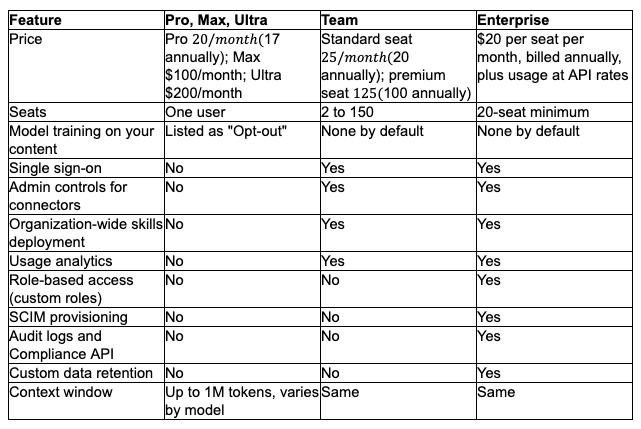
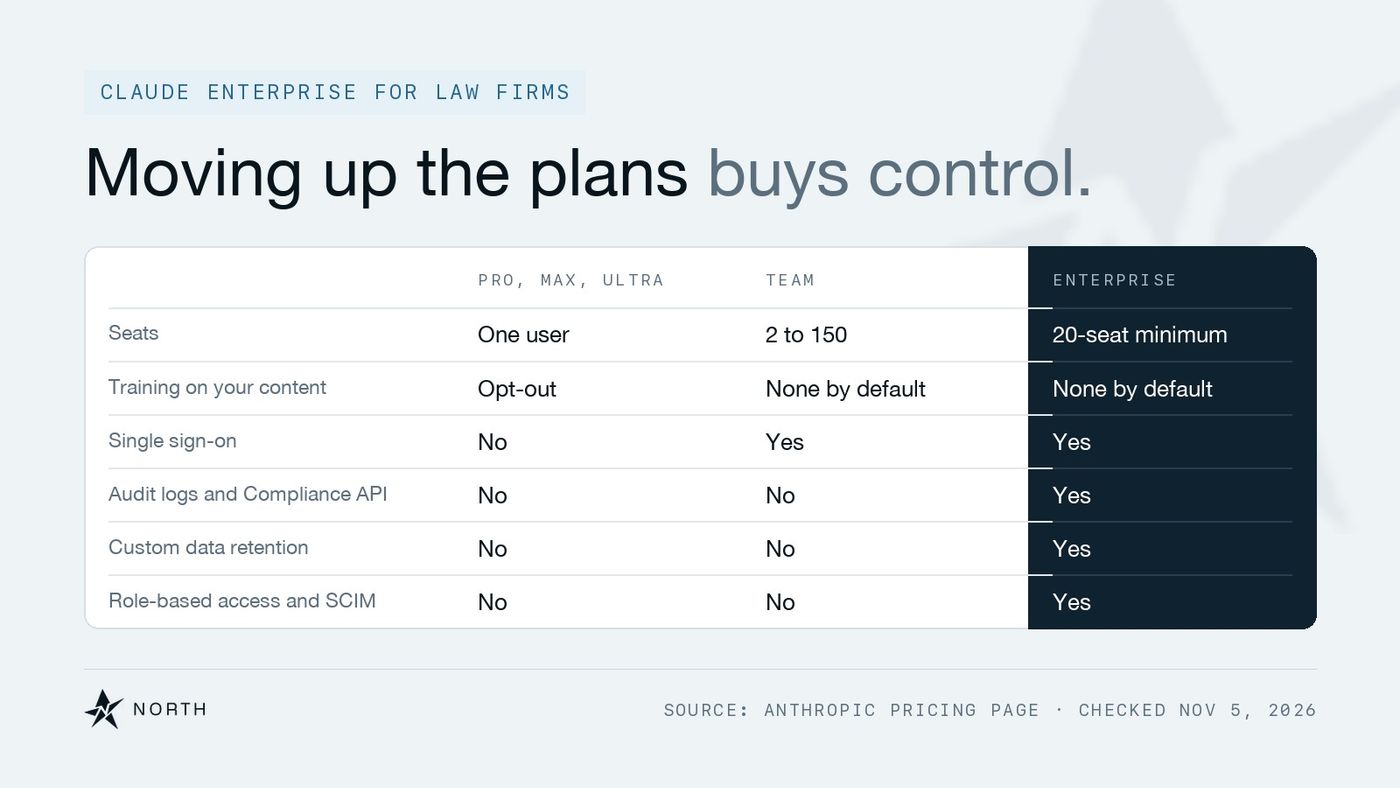
Two details matter more than they first appear. The context window is the same on every plan, so a firm doesn't upgrade to read longer documents. And Claude Cowork, Anthropic's agent workspace where Claude for Legal's practice-area plugins run, is available on every paid plan, from Pro through Enterprise. Moving up the plans buys control over who uses it and what gets recorded.
Individual plans: Pro, Max, and Ultra
These are personal subscriptions, with no single sign-on, no central billing, and no administrator who can see or switch off what a lawyer has connected. Anthropic's pricing table lists model training on individual plans as "Opt-out," meaning each user controls the setting.
A solo practitioner can make that work with care. A firm where even two lawyers share matters gets very little firm-level control from these plans.
Claude Team
Team is the first plan a firm administers as a firm. Owners get single sign-on, central billing, controls over which connectors members can use, usage analytics, and organization-wide skills deployment, so a skill encoding the firm's standard lease review positions can be pushed to every associate at once. Content isn't used for model training by default.
Team's limits show up in Cowork. An owner can turn Cowork on or off for the whole organization, and per-group capability controls are an Enterprise feature.
Claude Enterprise
Enterprise adds the controls an IT lead or a client's security questionnaire tends to ask about. Custom roles let owners decide which groups can use chat, Cowork, web search, and specific connectors, down to individual connector tools. Groups can be synced from an identity provider such as Okta or Entra ID through SCIM, per Anthropic's role-based permissions guide.
Audit logs and the Compliance API let the firm pull activity, chat data, and file content into its own monitoring tools. Custom retention lets owners set how long chats and projects are kept.
Pricing works differently, too. The seat costs $20 a month, and usage is billed at API rates on top of it, so the monthly cost rises with how heavily people use it and which models they choose. Anthropic offers a self-serve version and a sales-assisted one, with consultation and trials listed only on the latter. The 20-seat minimum is the self-serve route. Anthropic's help center lists a 50-seat minimum for sales-assisted Enterprise.
When does Claude Enterprise make sense for a law firm?
Governed AI for law firms comes down to what the firm can prove afterward. For firms that need between 20 and 150 seats, both plans are on the table. Four questions usually settle it.
Will anyone ask you to prove who accessed what? Some client security reviews and internal investigations need a record of user activity. Team owners can stream Cowork events to a security tool through OpenTelemetry, but Anthropic says that doesn't replace audit logging for compliance purposes, and Team has neither audit logs nor the Compliance API. On Enterprise, the Primary Owner can turn the API on and feed it to the firm's existing security tools.
Do client terms limit how long you keep data? If outside counsel guidelines cap retention, the firm needs a setting it controls. Enterprise lets owners set a custom period, with a 30-day minimum, and data is kept indefinitely until they do. Team has no such setting.
Local Cowork sessions add a wrinkle on Team and Enterprise alike. Anthropic's help center says their history is stored on the user's computer, outside its standard retention policies, and admins can't centrally delete it. Enterprise admins can retrieve the last 30 days of those sessions (or the firm's retention period, if shorter) through the Compliance API.
Do practice groups need different access? A firm that wants Cowork live for its real estate group on day one, and for its litigators only after a pilot, needs custom roles. On Team, everyone in the organization gets the same Cowork setting.
How much staff turnover does IT handle? Laterals, summer associates, and departing staff are easier to manage when access follows the firm's directory. SCIM is Enterprise only.
If none of those apply yet, Team is a sound starting point at 20 to 40 seats, and a firm can revisit the decision as clients ask harder questions.
What does AI cost for a 20-person law firm, and which plan fits?
Count everyone who will use Claude, then add the hires you expect over the next year. A 14-lawyer firm with six paralegals and assistants on Claude already needs 20 seats. On Team, 20 standard seats billed annually come to $400 a month. On Enterprise, the same 20 seats are $400 a month plus usage at API rates.
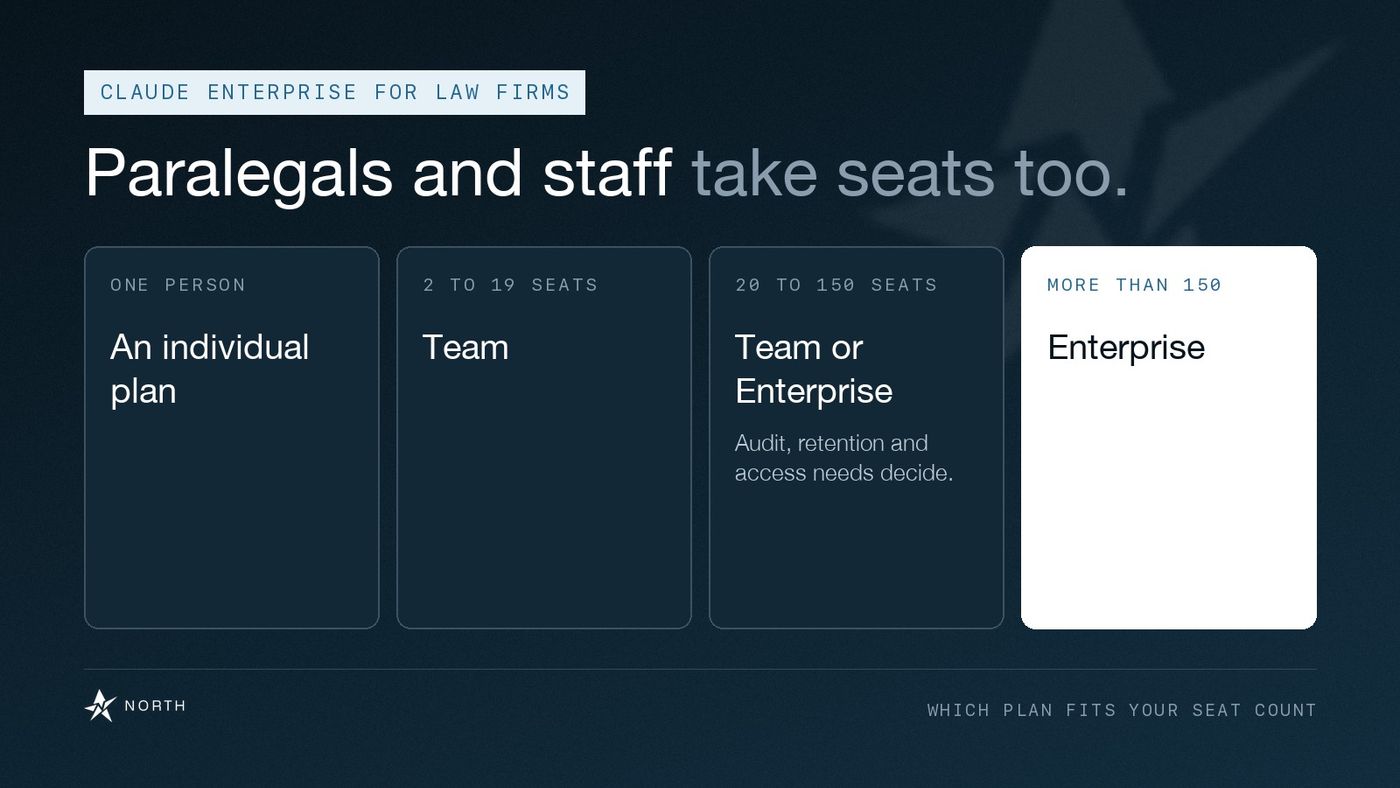
- One person: an individual plan can work, with the training setting checked and the lawyer's obligations under ABA Formal Opinion 512 reviewed before client material goes in.
- 2 to 19 seats: Team. Enterprise isn't available below 20 seats.
- 20 to 150 seats: Team or Enterprise, decided by the four questions above. Firms whose practice groups need separate access, or whose clients audit their vendors, should lean toward Enterprise.
- More than 150 seats: Enterprise, since Team stops at 150.
Where does the legal artifacts gallery fit?
Anthropic's legal artifacts gallery arrived on October 28. The announcement lists the product as Claude Enterprise and doesn't say whether Team or individual plans get the gallery. When it launched, we wrote in Claude for Legal Setup that since the gallery shipped as a Claude Enterprise release, most firms would begin setup on Enterprise.
For the gallery itself, that still holds. If ready-made artifacts are the main reason you're buying, plan on Enterprise, or confirm Team access with Anthropic before you commit. The seat minimum is why this post's advice differs for smaller firms: a firm that needs fewer than 20 seats can't buy Enterprise, and the practice-area plugins that run inside Cowork are included on Team.
Who can set it up?
Picking the plan is the quicker half of the project. Some firms run the setup with an internal technology lead. Others bring in outside help, and the trade-offs between consultancies, agencies, and legal specialists are covered in our guide to choosing a Claude implementation partner.
At North, we handle that setup on-site through North Deploy, and North OS brings the firm's documents, email, and matters into every Claude conversation. Then we stay on as the firm's external Chief AI Officer, bringing model updates, new skills and a monthly read on adoption. We focus on transactional practices at small and mid-size firms, especially those of about 15 to 30 people, as our Claude implementation page describes, so a large, litigation-focused firm should weigh that fit carefully.
Frequently asked questions
Is Claude Enterprise worth it for a small firm?
It depends on seats. A firm that needs fewer than 20 seats can't buy it and is well served by Team. Between 20 and 150 seats, Enterprise earns its cost when the firm needs audit logs, custom retention, directory-synced access, or different permissions by practice group. Above 150 seats, Enterprise is the only organizational plan.
Claude Team vs. Enterprise: what's the difference?
Both include single sign-on, connector admin controls, organization-wide skills, and no model training on content by default. Enterprise adds role-based access, SCIM, audit logs, the Compliance API, custom data retention, and a HIPAA-ready option, with seat pricing plus usage billed at API rates.
Can lawyers use Claude for Legal on the Team plan?
Yes, for the practice-area plugins. They run in Claude Cowork, which is available on all paid plans, and on Team an owner enables or disables Cowork for the whole organization. Anthropic's October 28 announcement of the legal artifacts gallery lists Claude Enterprise and doesn't state Team availability.
Does Claude train on a law firm's data?
On Team and Enterprise, Anthropic's pricing page lists model training on your content as "None by default." Anthropic's privacy center notes exceptions, such as feedback a user explicitly submits. On individual plans, training is an opt-out setting each user controls.
Picking a plan this quarter
For most firms, the seat count makes the first cut and one client's security questionnaire makes the second. If your largest client already asks for audit trails or retention limits, that answer points to Enterprise, provided you need 20 seats or more. If not, Team gets your lawyers working now and leaves the upgrade open.
If you'd like a second opinion on the plan before you commit, our team can talk it through with you.
Sources: Anthropic, Claude pricing (accessed November 5, 2026); Anthropic, Claude for the legal industry, May 12, 2026; Anthropic, Introducing artifacts for legal work, October 28, 2026; Claude Help Center, Use Claude Cowork on Team and Enterprise plans (accessed November 5, 2026); Claude Help Center, Manage custom roles on Enterprise plans (accessed November 5, 2026); Claude Help Center, Set up role-based permissions on Enterprise plans (accessed November 5, 2026); Claude Help Center, Access the Compliance API (accessed November 5, 2026); Anthropic Privacy Center, Configure custom data retention controls for Enterprise plans (accessed November 5, 2026); Anthropic Privacy Center, Is my data used for model training? (updated August 18, 2026); American Bar Association, Formal Opinion 512, July 29, 2024