

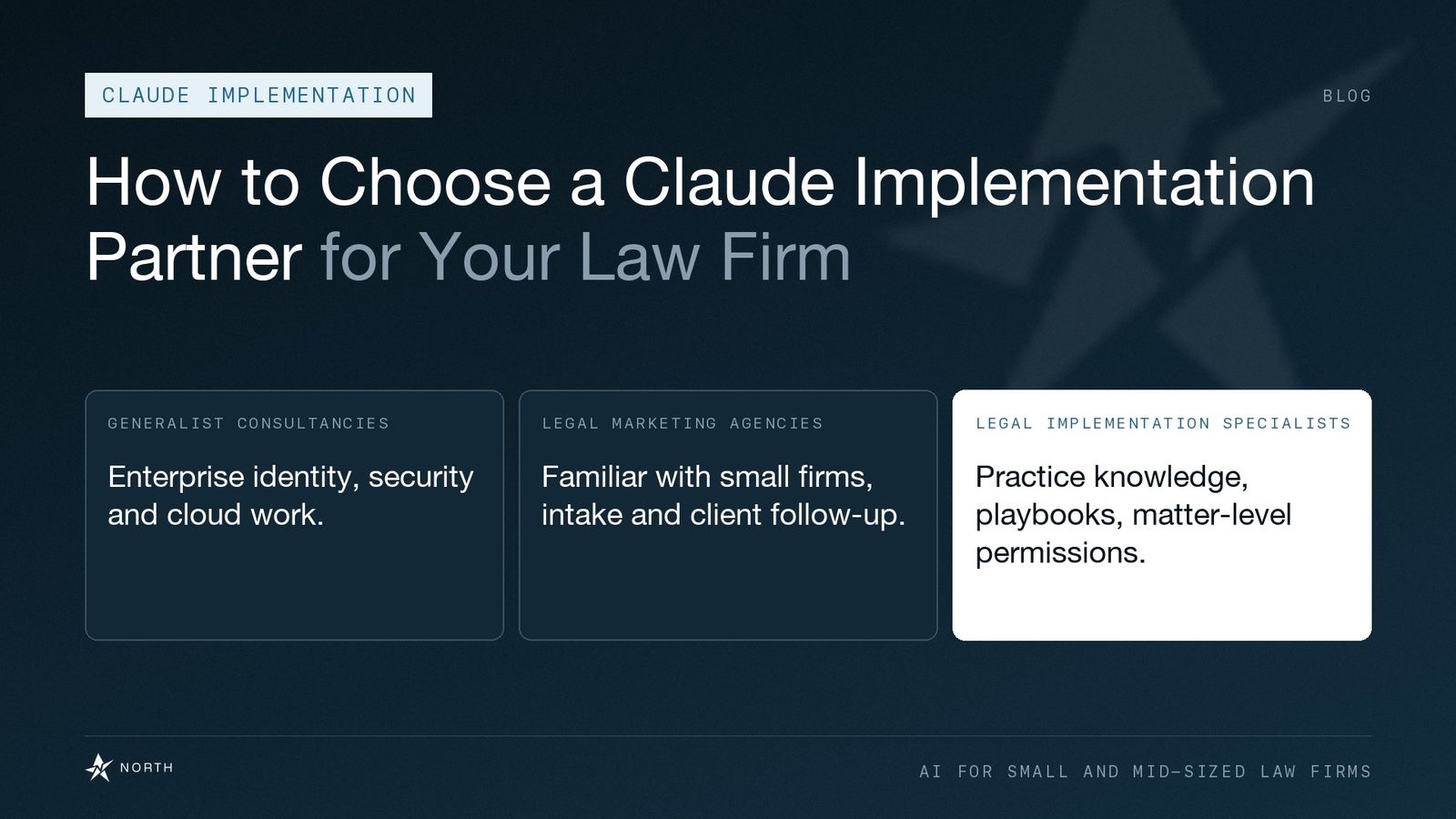
A Claude implementation partner is the team that connects Claude to a law firm's documents and systems, builds workflows around the firm's practice, and stays involved until lawyers use it as part of their daily work. For a law firm, the right Claude implementation partner understands legal work, shows up in person, and can point to a firm already running on what it built.
That definition is easy to agree with and hard to test in a sales meeting, because every firm selling legal AI implementation now uses similar words. This guide covers what the work includes, who offers it, and the questions that show which kind of partner you're talking to.
Why do firms need a partner after buying Claude?
When Anthropic launched Claude for Legal on May 12, 2026, it shipped 12 practice-area plugins plus connectors for legal tools such as iManage, NetDocuments, Box, and Ironclad. The October additions, including an artifacts gallery and a list of implementation partners, are covered in our post on Claude for Legal setup.
What usually hasn't been decided is who does the work. A firm has three realistic ways to run the project: a lawyer or operations lead inside the firm, the outside IT provider it already pays, or a dedicated implementation partner.
The first two know the firm, and either can turn on single sign-on and install the desktop app. The questions are whether they have the hours, and whether they've ever turned a playbook into a skill or mapped an ethical screen onto a connector. A partner earns its fee when the answer to either is no.
Getting lawyers to use AI takes more than licenses, which we've covered in Why Tool Access Isn't Adoption. For one 25-person firm in New York, only 3 lawyers were using Claude at launch; two weeks later, 23 were, according to our published case study.
What does a Claude implementation partner do for a law firm?
The work comes in four pieces. Each one has a test you can run on a partner before you sign.
Connections to the systems that hold the work
The test: ask the partner to list every system it will connect, and which ones run on an existing Anthropic connector versus custom work. A typical firm keeps matter files in NetDocuments or iManage, matter and billing data in Clio, shared files in SharePoint, and years of correspondence in Outlook.
A new Claude account knows none of it. The goal is an associate asking about an asset purchase and getting an answer drawn from the deal file, with each point cited to its document. Anthropic's own connectors cover some of these systems, and the rest take configuration that has to be tested against what lawyers expect.
Access controls that mirror matters and ethical walls
Ask for a test account on each side of a real ethical screen, and watch what each one can retrieve. If a lateral is screened from a matter in iManage, Claude shouldn't surface that matter's documents to her.
Anthropic says several of its legal connectors respect the source system's rules, with Box enforcing existing access policies and Ironclad scoping results to each user's permissions, per its Claude for Legal overview. Your partner should prove it on your systems before anyone touches client work.
Skills built for the practice
The test: ask how many positions in your NDA playbook the skill will encode, and what it does with a clause the playbook doesn't address. Claude for Legal's plugins are a general starting point. Your fallback positions on indemnity caps, the way your real estate group abstracts a lease, and the order your closing checklist runs in are specific to your firm.
Implementation turns those into skills, meaning governed workflows a whole practice group runs the same way. At North, we tune skills from our library of more than 200 for transactional work to each firm's playbooks and house style, drawing on our skills library.
Training inside live matters, then ongoing support
Before you sign, find out whose matters the trainers will sit in on during week one, and who checks usage a month later. Training belongs on the firm's own files, which we cover in Claude Training for Law Firms. After launch, skills need retesting when Anthropic releases a new model, and practice groups will ask for new workflows.
Most partners will say they handle all four. They differ on practice knowledge, the size of engagement they're built for, and how much time they spend in your office.
Who offers Claude implementation today?
Three kinds of firms tend to come up when a managing partner starts looking for a Claude deployment partner. Each has real strengths and a gap worth knowing about.
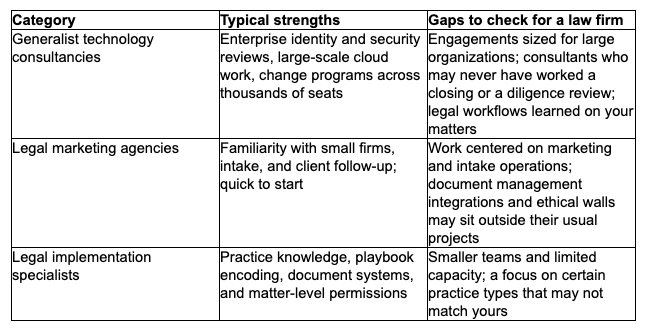
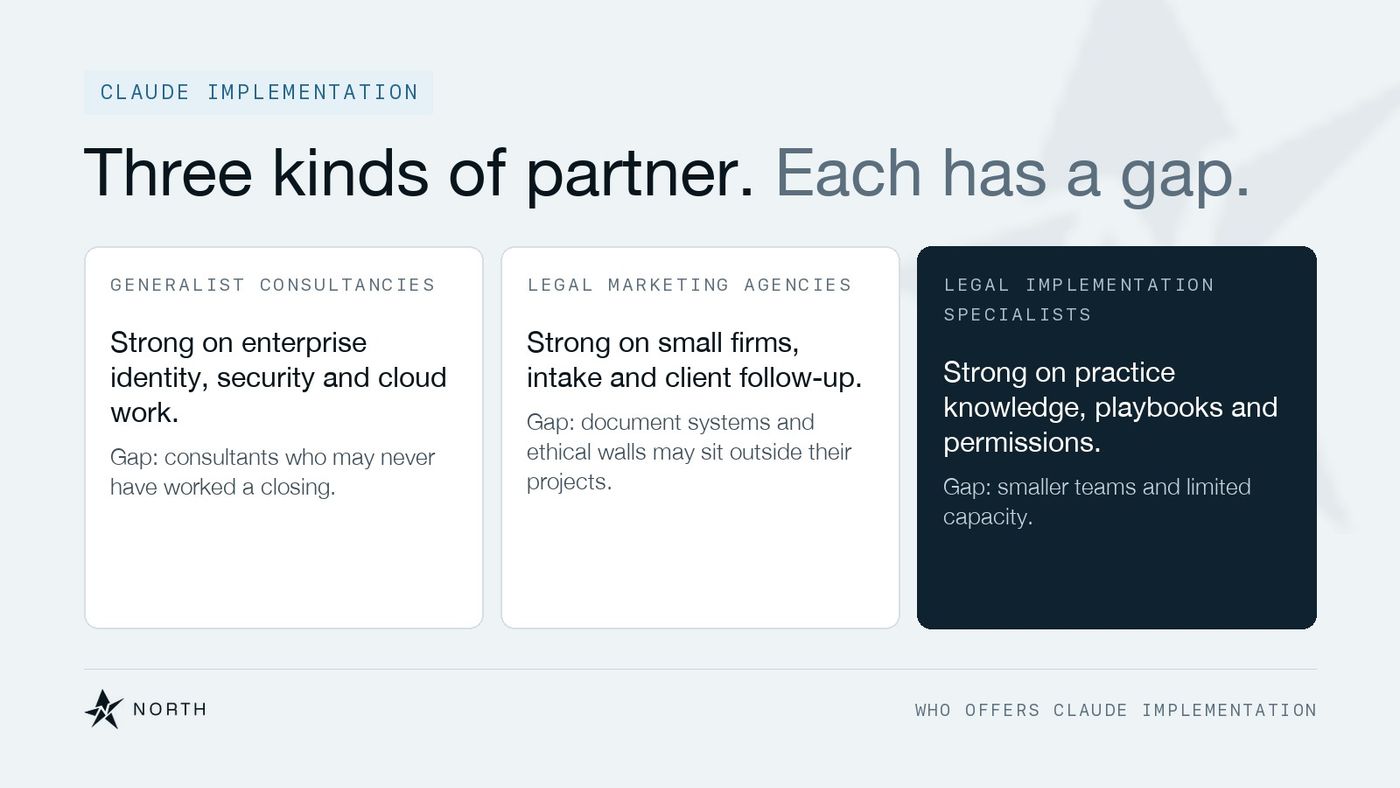
Most of the 13 firms on Anthropic's partner list for legal rollouts are global consultancies and technology services firms. For a 20-lawyer buyer, the useful follow-up is the third question in the table below: which law firm is running on what they built.
We sit in the third row, and its gap applies to us. Our implementation work is built for transactional firms, especially those of roughly 15 to 30 people without an innovation team. A litigation-heavy firm should ask us, and anyone else, how much of a partner's skill library fits its actual docket.
What should you ask a partner before you sign?
Put the same six questions to every partner on your shortlist, us included. Strong answers name people, days, and numbers. Weak ones drift back to product features.
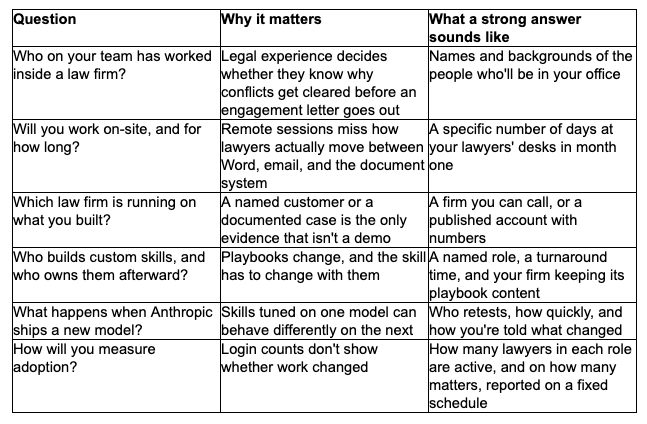
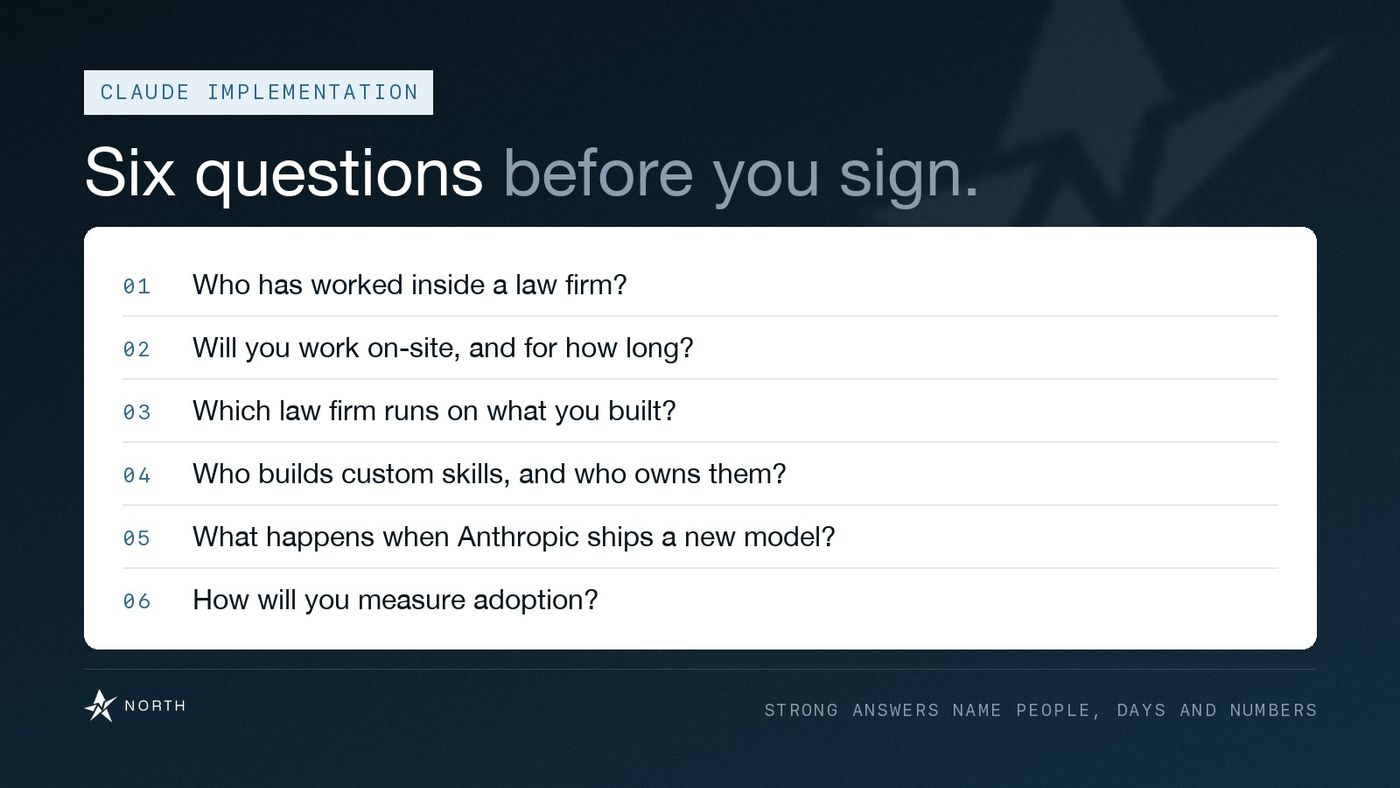
Here's how we answer the ones we can point to in writing. At the firm in our case study, one of our Forward Deployed Legal Engineers worked from the firm's office for an entire week, going desk by desk through real deals, then returned monthly and kept training the team remotely each week.
That case study describes the firm by size and city without naming it, so asking us for a reference is a fair request. After rollout, we stay on as the firm's external Chief AI Officer: model updates, new skills, and a monthly read on adoption. Firms can copy and adapt any skill in our library, or write their own.
What do the first 30 days of on-site AI deployment look like?
Our Claude implementation page sets out the first month. Our engineers spend time with your lawyers learning how the work actually moves, Claude gets wired into the systems your matters live in, and two workflows the firm runs constantly are switched on. Partners get onboarded ahead of the rest of the firm.
For a transactional firm, those two might be NDA triage and a closing checklist kept current as the deal moves. On that page, we say that most firms reach their first live workflows within 10 days and use across the firm by day 60. Our homepage notes that timing depends on each firm's systems and priorities.
At the case study firm, we tracked usage every week so we could call anyone who went quiet. The on-site side of that work is what we call North Deploy. If your firm hasn't chosen a Claude plan yet, our guide Claude Enterprise for Law Firms: Which Plan Your Firm Actually Needs covers that decision.
Three things to write down first
Before you take a single sales call, list the systems your matters live in, the workflows that eat the most associate hours, and any client restrictions on where documents can go. Then put the six questions to two or three partners and ask each for a written 30-day legal AI implementation plan with names attached.
For background on Claude itself, start with Claude for Law Firms: Use Cases, Security, and Implementation.
Frequently asked questions
What is a Claude implementation partner?
An outside team a firm hires to take Claude from licensed to used. It does the technical setup against the firm's own systems and rules, then works alongside lawyers until the system is part of their routine. Anthropic sells the product, and the partner fits it to one firm's practice.
How long does Claude implementation take for a law firm?
It depends on the firm's systems and how many workflows it starts with. At North, our published expectation is that most firms see their first workflows running inside 10 days, with use across the firm by day 60.
Can a firm set up Claude for Legal on its own?
Yes, in part. Anthropic's legal plugins and connectors are open source, and Enterprise admins can enable them in workspace settings. What remains is the firm-specific work described in the four sections above, and firms that employ a technology lead can take on more of it.
Ready to interview us?
Book a 30-minute call. We'll go through your systems and the first workflows you'd start with, and you can put all six questions to us directly.
Sources: Anthropic, Claude for the legal industry, May 12, 2026; North, Claude for Legal Setup, October 29, 2026; Anthropic, Introducing artifacts for legal work, October 28, 2026; North, From 3 to 23: Claude for Law Firms Case Study, November 4, 2026; North, Claude Implementation for Law Firms (accessed November 5, 2026); North, North Deploy (accessed November 5, 2026)