

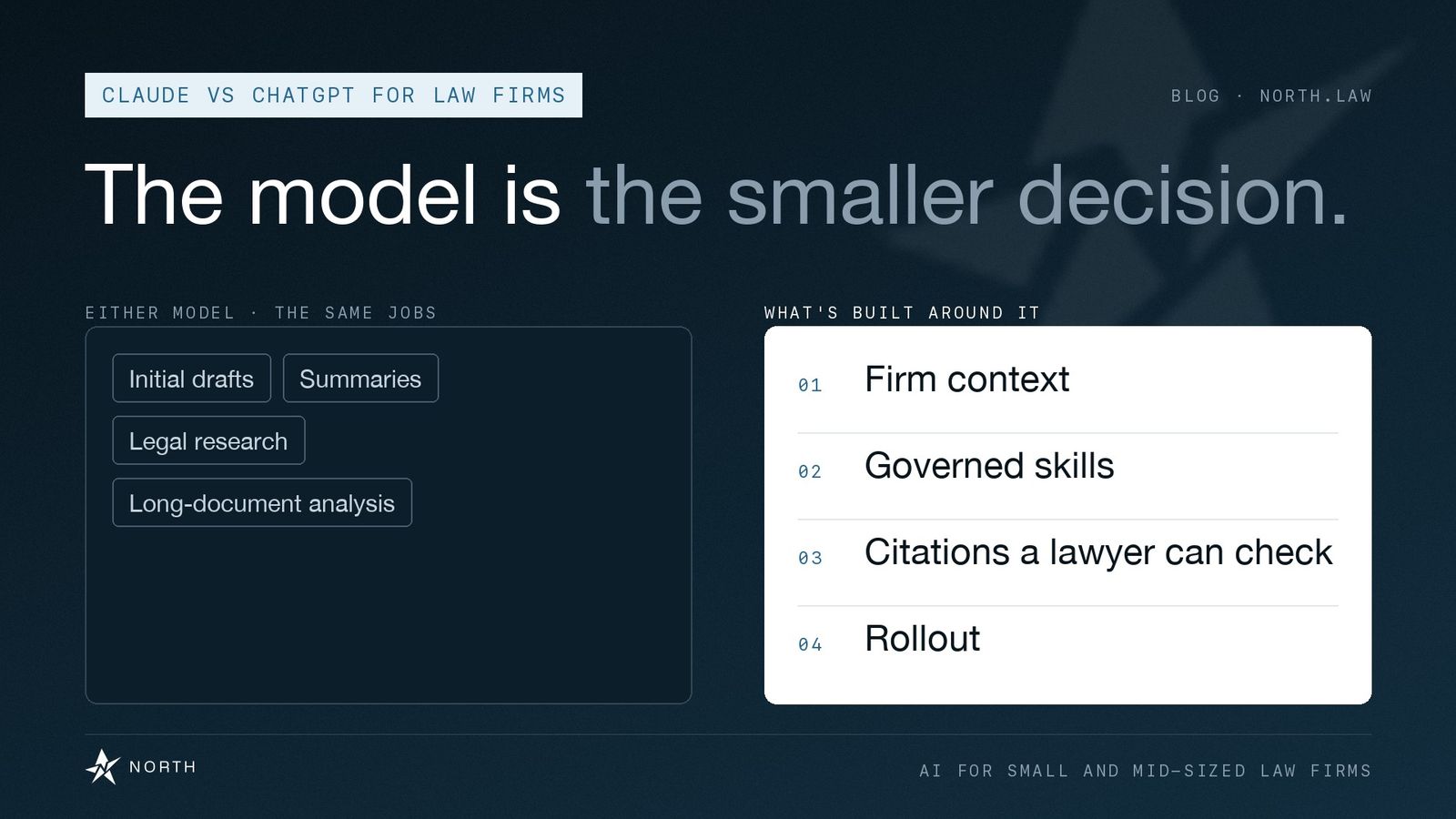
Both Claude and ChatGPT can draft and summarize legal documents. For a law firm, the real differences are how each handles long documents, careful reasoning, and client data, and whether anything is engineered around the model to make it safe and useful in practice.
Most lawyers compare the two by pasting the same clause into each and picking the better answer. That says little about what happens when an associate uploads a data room, or when a partner's personal account ends up holding a client's merger terms.
Below, we compare Claude and ChatGPT for law firms on what each can read at once, what each does with your data on each kind of account, and how each supports work a lawyer can check. Then we explain why the model choice is usually the smaller decision.
What do lawyers actually need from an AI model?
Start with the work. In ILTA’s 2026 Technology Survey of more than 500 member law firms, the leading AI uses fell between 73% and 79%: initial drafts, meeting notes and summaries, legal research, and analysis of long or complex documents, according to LawNext’s September 2026 reporting.
Those four jobs translate into four requirements.
Long-document handling. A credit agreement with six amendments, a lease portfolio for an acquisition, or a witness's emails before a deposition need to be read together, because the answer often sits in how two documents interact.
Careful reasoning. A model that summarizes a change-of-control clause has to notice the carve-out three sections later. A smooth paragraph that misses it is worse than no summary, because it reads as finished.
Low hallucination, with a way to check. No model is free of errors. What matters is whether every statement can be traced back to the document it came from, so an associate can confirm it in seconds.
Data controls. A model is only usable on client files if the firm knows where that information goes, who can see it, and whether it trains anything.
The first three are about capability. The fourth depends on account terms, permissions, retention, integrations, and firm policy. A lawyer’s account choice is one part of that review.
How do Claude and ChatGPT compare on legal work?
This comparison reflects vendor documentation checked on October 29, 2026. Anthropic introduced Claude Opus 5.5 on September 22. OpenAI announced a broader GPT-6 rollout on October 7, following its first paid-customer releases in September. Availability and limits vary by model, plan, and product surface.
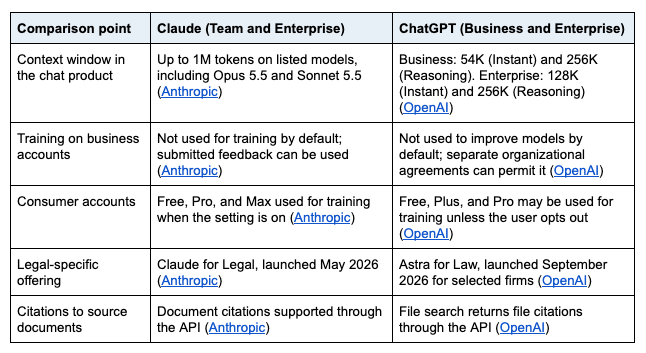
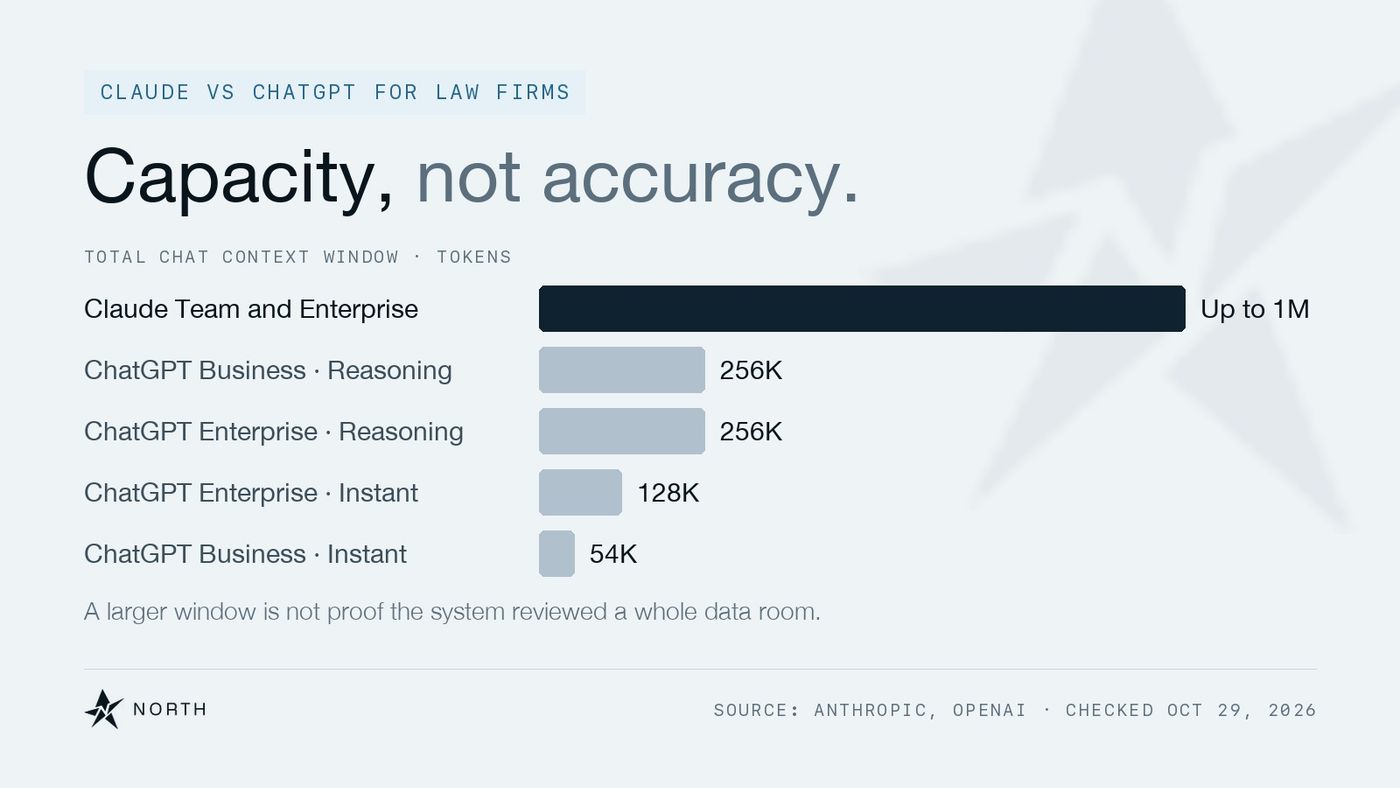
Context length is a capacity measure, not an accuracy score. Claude’s listed 1M-token windows are larger than the ChatGPT Business and Enterprise chat windows in the table. But a total context window is not an upload allowance: instructions, conversation history, tool use, and output consume capacity too. Retrieval can also work with a document collection larger than the active window. Test whether the system finds amendments, exceptions, and conflicting provisions reliably; do not assume a larger window means it has reviewed an entire data room correctly.
Reasoning and writing need a task-specific test. Vendor demonstrations and benchmark results can help frame a trial, but they do not establish which product will perform best on your firm’s matters. OpenAI’s Astra for Law announcement reports legal-research evaluations of its configured system. That is different from an independent comparison of ordinary ChatGPT and Claude subscriptions. Test drafting, issue spotting, source accuracy, and review time on the same approved documents. Neither model should be treated as a substitute for checking the law.
Both vendors now sell to law firms directly. Anthropic's Claude for Legal added practice-area plugins and connectors to legal software. OpenAI’s Astra for Law combines GPT-6 Astra with a legal search index and legal instructions. Its announcement describes initial access for selected firms through Trusted Access in ChatGPT and Codex, with API access coming later, and API zero data retention for eligible firms. Those terms should not be assumed to apply to every ChatGPT subscription. OpenAI also says its forward-deployed engineers have adapted ChatGPT Enterprise for selected firms. Both vendors now build for customization around a firm's practice. For a 20- or 200-lawyer firm, the open question is who does that shaping.
Does either one train on your data?
Both vendors exclude business inputs and outputs from training by default, but the exceptions matter. Anthropic’s commercial data policy allows training on explicitly submitted feedback or other permitted sharing; Team and Enterprise owners can disable feedback submission. OpenAI’s business data policy says business-workspace feedback does not itself authorize training; a separate organizational agreement can allow model improvement, and API owners can enable sharing. Check the settings and contracts for the service actually being used.
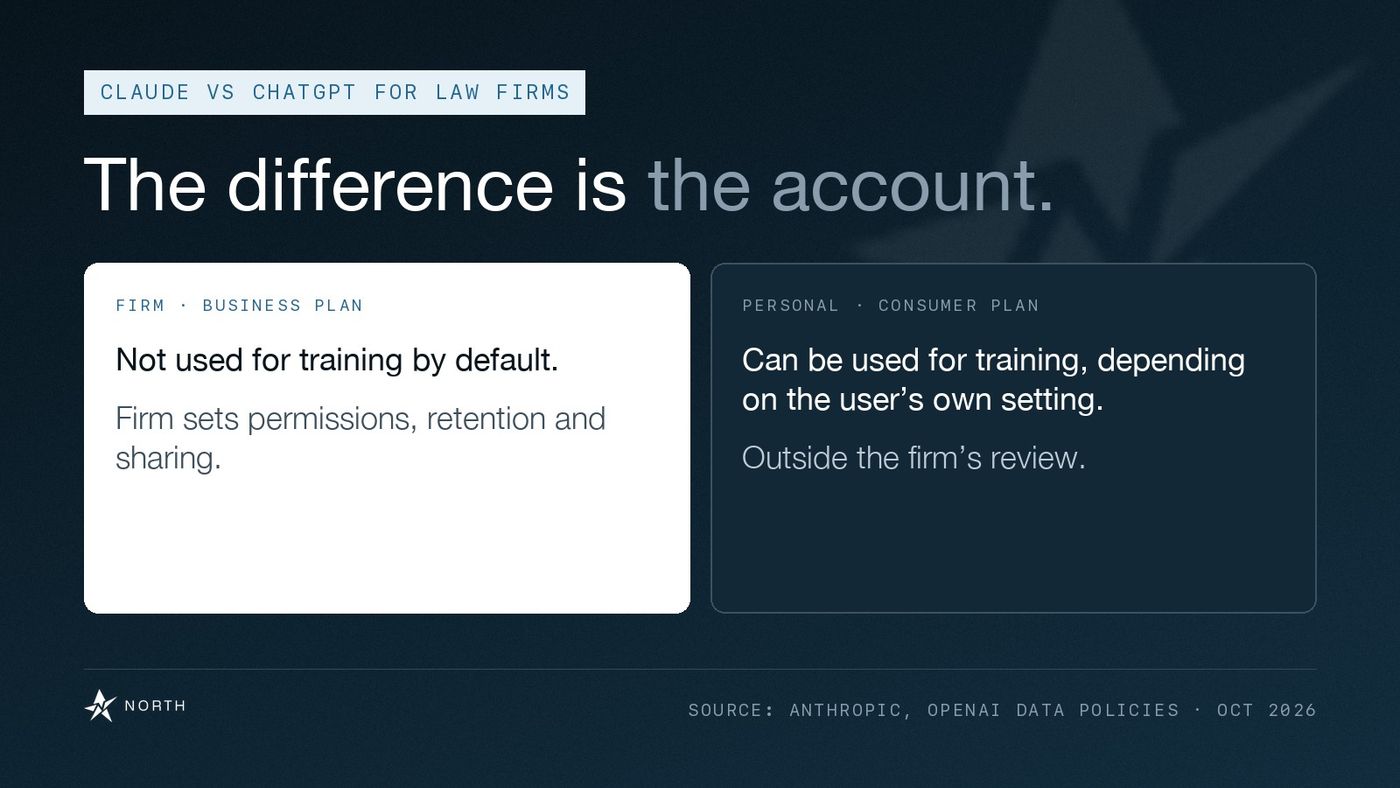
The difference that matters is between account types. Since Anthropic's consumer terms update in August 2025, Claude Free, Pro, and Max conversations can be used to train new models when the user's setting is on, and Anthropic extended retention to five years for users who allow it. OpenAI's consumer plans (Free, Plus, and Pro) may be used for training unless the user turns off "Improve the model for everyone" in Data Controls.
Training isn't the only exposure. In the New York Times copyright case, OpenAI was ordered to preserve consumer and API content, including ChatGPT Team conversations. OpenAI says that obligation ended on September 26, 2025, that limited data from April to September 2025 remained subject to preservation in its October 2025 update, and that Enterprise and Edu accounts were never covered. The historical order illustrates why no-training commitments and retention rules are separate questions; it is not a claim that the same preservation order remains in force today.
LawNext also reports that, in ILTA’s 2026 survey, generative AI appeared on firms' list of their three biggest security challenges for the first time and placed second, behind only user behavior. Unmanaged personal accounts are an exposure firms should address, whichever vendor they use. In United States v. Heppner, No. 25-cr-503 (S.D.N.Y., February 17, 2026), the court rejected privilege and work-product claims over documents the defendant generated using Claude without counsel’s direction. The ruling considered the absence of an attorney relationship with Claude, confidentiality under the applicable terms, and the purpose of the communications. It does not establish that selecting a commercial account makes AI conversations privileged. The Harvard Law Review Blog’s analysis questions aspects of the court’s reasoning; it is commentary, not the holding.
Before uploading client information, assess applicable confidentiality duties, client restrictions, retention, provider access, connected services, and whether informed consent is required. ABA Formal Opinion 512 addresses lawyers’ duties when using generative AI. A paid plan and a no-training default do not complete that assessment.
Why does the model matter less than what's built around it?
A firm-approved business plan is a starting point. Training exceptions, retention, permissions, and professional duties still need review. Same model, different outcome: two firms can license the identical model and get very different results, depending on four things around it.
Firm context. Whether your lawyers use Claude or ChatGPT, a model that has to be told about the matter every time is a fast typist with no memory of the file. A model connected to the firm's documents, emails, and matters can answer a partner's question about a deal from the record the firm already holds.
Governed skills. A prompt lives in one associate's notes. A skill encodes a repeatable method for a task. Its outputs still need testing and lawyer review. Our NDA Review skill, for example, reads an inbound NDA against the firm's playbook positions and sorts it green, yellow, or red, with the reasoning for the call. Tabular Review runs the same question set across a data room and cites every cell to the source clause, so a deal team checks the grid in place of hunting through documents. Contract Review flags off-market terms and suggests redlines in the firm's drafting style.
Citations a lawyer can check. Both vendors offer citation features to developers. Whether a lawyer actually sees a source next to every claim depends on how the system is built. We cover the review problem in Why Citations Matter More Than Confidence Scores. A source link is a starting point for verification: confirm that the passage supports the claim and, for legal authorities, that it remains good law.
Rollout. Someone has to connect the firm's systems, set permissions matter by matter, and train lawyers on their own files.
None of this is specific to one model. If your firm has standardized on ChatGPT Enterprise, the same four questions apply.
Why North builds on Claude
We made a choice, and we'll say plainly why. We don't sell a wrapper. We build on Claude itself, and the full case for that is in Claude for Law Firms: Use Cases, Security, and Implementation. This comparison adds two practical reasons.
The first is document capacity: Anthropic’s current plan documentation lists 1M-token chat windows for several models. The second is integration with legal workflows: Claude for Legal brings practice-area plugins and connectors into the product. These are reasons for our choice, not proof that Claude is best for every firm. Existing connectors can reduce some integration work, although permissions and configuration still need attention. Separately, in ILTA's 2026 survey, 44% of firms were using or exploring Claude, level with CoCounsel and above ChatGPT Enterprise at 22%, per LawNext. These figures combine use with exploration and compare a broad Claude category with ChatGPT Enterprise; they are not market-share figures or evidence of superior performance.
Claude is the starting point. North OS connects Claude to the firm's emails, documents, matters, meeting recordings, and skills, with 200+ governed skills in the library. North Deploy puts our Forward Deployed Legal Engineers in your office to wire it into the systems you already run and train your people on their own matters. The deployment is designed around firm permissions, governed skills, and source-linked outputs. The firm should verify those controls in its own setup, including feedback-sharing settings and the applicable no-training terms. Citations support review; they do not guarantee that every conclusion is correct.
Claude is a product of Anthropic. North is an independent deployment partner, and our job is the part between a license and a firm that uses it every day. That work is laid out step by step on our Claude implementation page.
Before your firm picks a model
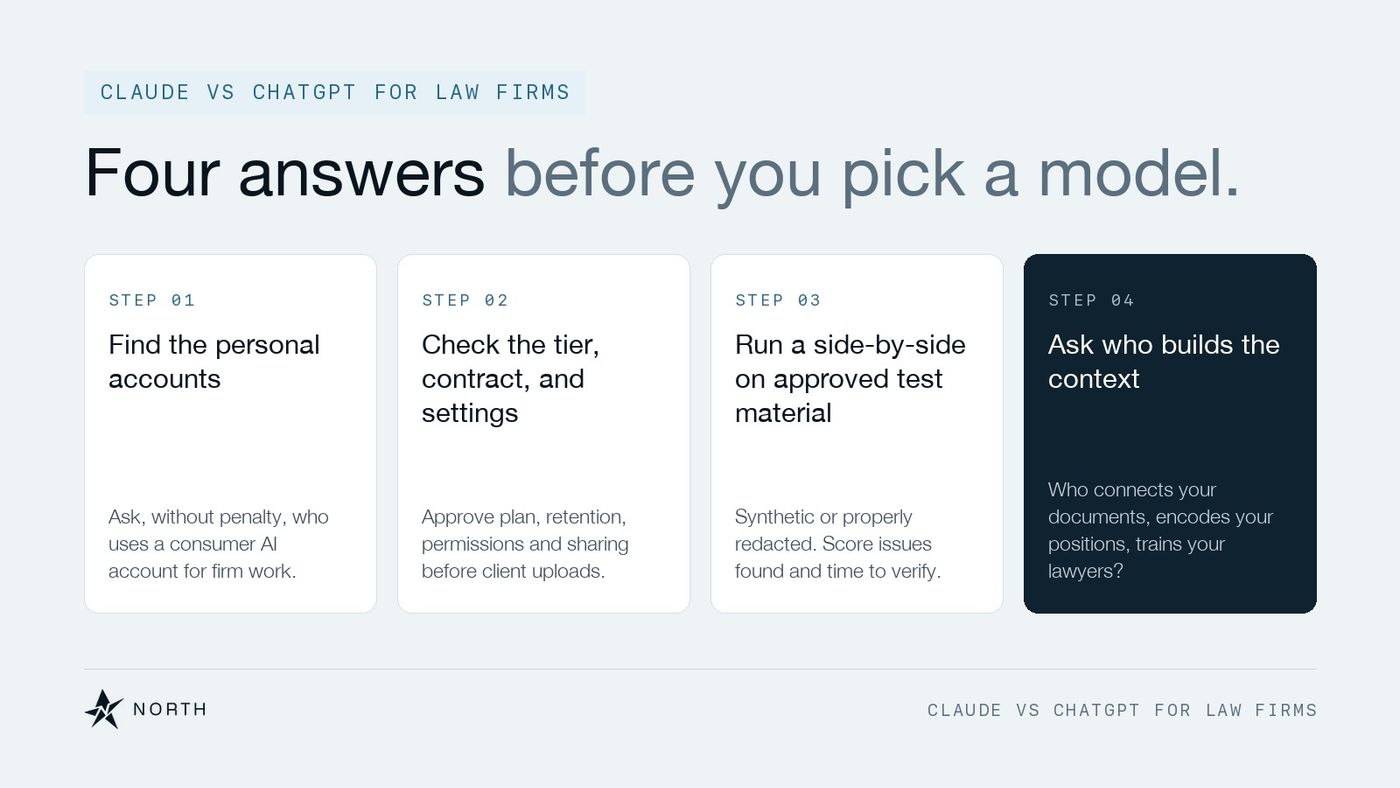
Before choosing between Claude and ChatGPT, a managing partner can settle the parts that matter more:
- Find the personal accounts. Ask, without penalty, who uses a consumer AI account for firm work. Bring that use into the firm’s review and approval process, whichever model you choose.
- Check the tier, contract, and settings. Approve the plan, retention, permissions, connected services, and sharing settings before client uploads.
- Run a side-by-side on approved test material. Use a synthetic agreement or properly redacted material the firm has approved. A closed matter can still be confidential. Score issue detection, source support, drafting quality, and the time needed to verify each result.
- Ask who builds the context. Whoever sells you the model, ask who connects your documents, encodes your positions, and trains your lawyers.
When the Claude vs. ChatGPT for law firms question comes up at your next partner meeting, those four answers will settle more than any benchmark. If the answers point to Claude, the next decision is how it reaches every lawyer in the firm.
Frequently asked questions
Is Claude better than ChatGPT for lawyers?
Neither is better at every task. The listed Claude chat models offer larger context windows than the ChatGPT business-plan windows compared here, but capacity does not establish legal accuracy. Evaluate both on your firm’s approved workflows and include the time lawyers spend checking the output.
Is ChatGPT safe for confidential client information?
ChatGPT Business, Enterprise, and Edu exclude business data from model improvement by default. That alone does not determine whether a particular upload is appropriate. The firm must approve the terms, retention, permissions, connected services, and use under its client obligations. Consumer-plan settings are controlled separately.
Can law firms use Claude for client work?
Potentially, after the firm approves the service and intended use. Commercial inputs and outputs are excluded from training by default, but submitted feedback can be used; Team and Enterprise owners can disable feedback submission. Firms still need appropriate permissions, confidentiality and retention review, source checks, and lawyer supervision. A commercial plan does not guarantee privilege.
See Claude engineered for your firm
On a 30-minute call, we'll walk through how Claude would run inside your firm: the systems it connects to, the skills your practice would start with, and the controls around client files. Book a call, or read how Claude implementation for law firms works first.
Sources: ILTA 2026 Technology Survey, via [LawNext, September 2026](https://www.lawnext.com/2026/09/which-ai-product-is-most-popular-among-law-firms-findings-of-iltas-tech-survey-may-surprise-you.html); Anthropic, [How large is the context window on paid Claude plans?](https://support.claude.com/en/articles/8606394) (accessed October 2026); OpenAI, [ChatGPT Business pricing](https://openai.com/business/pricing/) (accessed October 2026); Anthropic, [Introducing Claude Opus 5.5](https://www.anthropic.com/claude-opus-5-5); OpenAI, [GPT-6 and Intelligent UI for everyone, October 2026](https://openai.com/index/gpt-6-for-everyone/); Anthropic Privacy Center, [Commercial data use](https://privacy.claude.com/en/articles/7996868) (updated August 2026); Anthropic, [Updates to our consumer terms, August 2025](https://www.anthropic.com/news/updates-to-our-consumer-terms); OpenAI Help Center, [How your data is used to improve model performance](https://help.openai.com/en/articles/5722486) (updated October 2026); Anthropic, [Claude for the legal industry, May 2026](https://claude.com/resources/articles/claude-for-the-legal-industry); OpenAI, [Astra for Law, September 2026](https://openai.com/index/astra-for-law/); Anthropic, [Citations documentation](https://platform.claude.com/docs/en/build-with-claude/citations); OpenAI, [File search documentation](https://developers.openai.com/api/docs/guides/tools-file-search); OpenAI, [How we're responding to The New York Times' data demands, updated October 2025](https://openai.com/index/response-to-nyt-data-demands/); United States v. Heppner, [opinion, S.D.N.Y., February 2026](https://storage.courtlistener.com/recap/gov.uscourts.nysd.652138/gov.uscourts.nysd.652138.27.0.pdf); Harvard Law Review Blog, [United States v. Heppner, March 2026](https://harvardlawreview.org/blog/2026/03/united-states-v-heppner/)