

Harvey is a multi-model legal AI platform that law firms and in-house teams log into, and as of November 2026 it sells to everyone from boutiques to most of the AmLaw 100. North engineers Claude into a firm's own systems and puts legal engineers in its office, and we build for 15 to 30 person transactional firms. Which one fits depends on where you want your lawyers working, how much hands-on rollout you need, and whether you also want a research library in the same product.
A managing partner at a 25-lawyer transactional firm sees a serious company in Harvey: 80% of AmLaw 100 firms use it, Harvey says. The practical question is whether it fits a firm with no innovation team, and what a Harvey alternative would look like.
We checked Harvey's own site, blog, and press releases on November 5, 2026, and describe Harvey the way it describes itself, including where it may suit your firm better than we would.
What is Harvey?
Harvey calls itself AI software for legal and professional services. It bundles Agents that plan multi-step work and return cited output for review, Vault for analyzing large document sets, Knowledge for legal, regulatory, and tax research, Spaces for working alongside clients and co-counsel, and Command Center for seeing who uses Harvey and on what work. It also works in Outlook and Word, where custom agents now run inside the open document.
Models. Harvey is multi-model by design, drawing on models from Anthropic, Google DeepMind, and OpenAI. Administrators decide which models their organization can use, and lawyers can pick one from a model selector. Recent additions include Claude Opus 5 in July 2026 and, per its October 2026 release notes, Anthropic's Fable 5.1 and OpenAI's GPT-6 Astra. Its September funding announcement also mentions Harvey's first post-trained open-weight model.
Customers and funding. Harvey's homepage counts more than 3,500 law firms and in-house legal teams. Its September 9, 2026 release announced $550 million at a $15.5 billion valuation, co-led by Diffusion and Lightspeed Venture Partners. Large firms aren't its only market. Harvey's page for mid-sized and small firms says it's designed for firms of every size, "including boutique, specialty, and mid-sized firms of roughly 15 to 150 lawyers," and counts more than 2,300 such firms.
Deployment and data. Harvey's security page says the platform is hosted in Microsoft Azure, with EU, Switzerland, or Australia processing available. Harvey contractually guarantees that inputs, outputs, and uploaded documents aren't used to train underlying models, requires zero data retention from model providers for its core service, and enforces a firm's existing ethical walls.
Rollout support. For mid-sized firms, Harvey offers a Customer Success Manager who owns the rollout, legal engineers who "shape your first workflow around the work slowing you down most, then hand it over," and Harvey Academy for on-demand training. Its Transformation Office, launched in May 2026, works with a select group of strategic partners on adoption plans. And in March, Harvey said it would use new funding to scale the embedded legal engineering teams that build agents inside top law firms and legal departments.
Pricing. Harvey doesn't publish pricing. Its site has no pricing page, only demo requests.
What is North?
At North, we build around one model: your lawyers work in Claude, and we engineer the firm into it. Three pieces make that up.
The first is Claude itself, on Anthropic's business plans, including the practice-area plugins and connectors in Claude for Legal. Our Claude for Legal explainer walks through what Anthropic includes.
The second is North OS, a custom Claude for law firms: it links Claude to the firm's email, documents, matters, and meeting recordings, and adds a library of more than 200 governed skills. It works with systems firms already run, including NetDocuments, iManage, SharePoint, Outlook, Word, and Clio. Answers cite their sources, permissions follow the firm's existing access controls, and Claude doesn't train on firm data.
The third is North Deploy, the install. Our Forward Deployed Legal Engineers work inside your office, tune skills to your playbooks and house style, and train lawyers on their own matters. Once rollout ends, North stays on in what we call an external Chief AI Officer role, taking on model updates and new skills and reviewing adoption each month. Our Claude implementation page sets out the 90-day plan. By our own count, most firms we deploy have their first workflows live within 10 days and firm-wide use within 60.
We scope pricing to each firm's size, systems, and priorities, and we outline costs before anyone commits. Neither company publishes a price list.
How do North and Harvey compare?
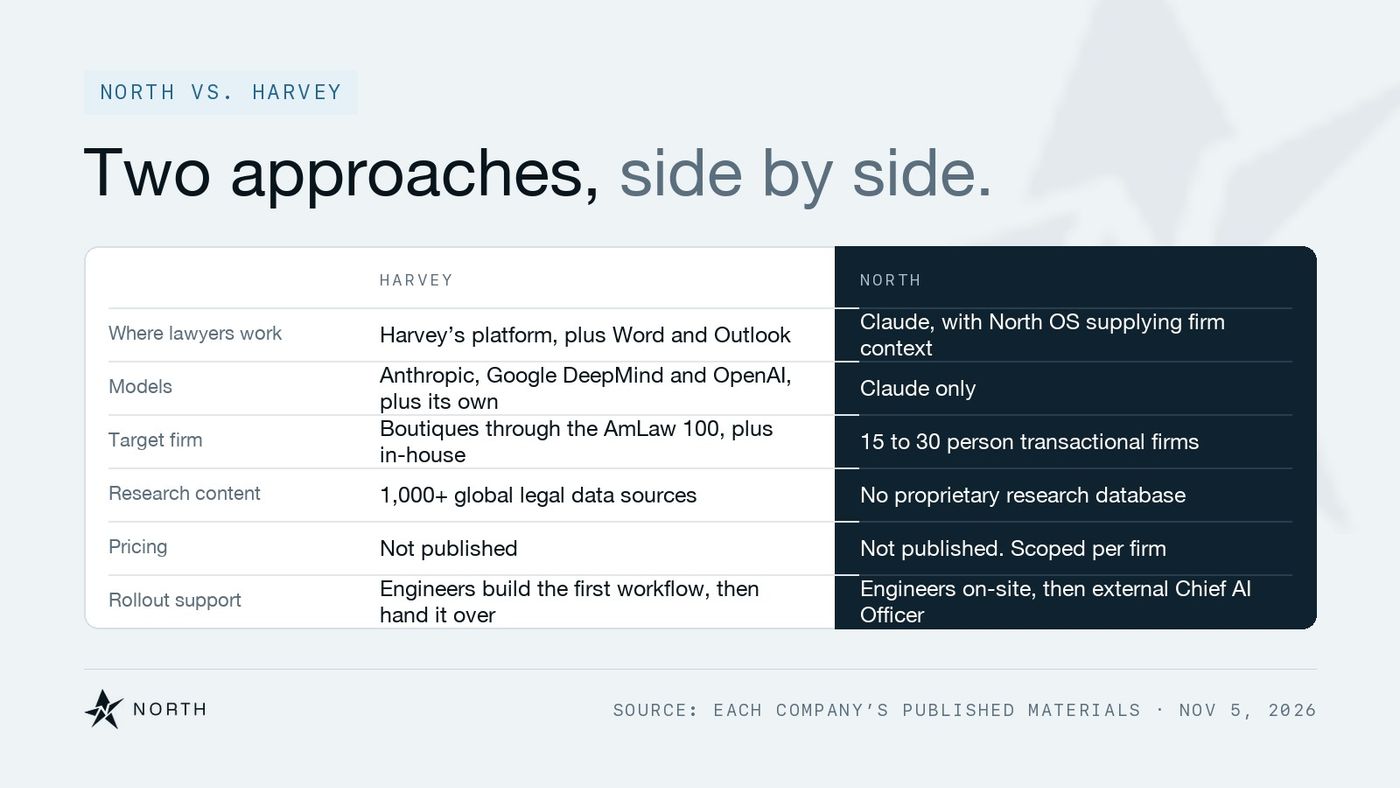
As of November 5, 2026, from each company's published materials:
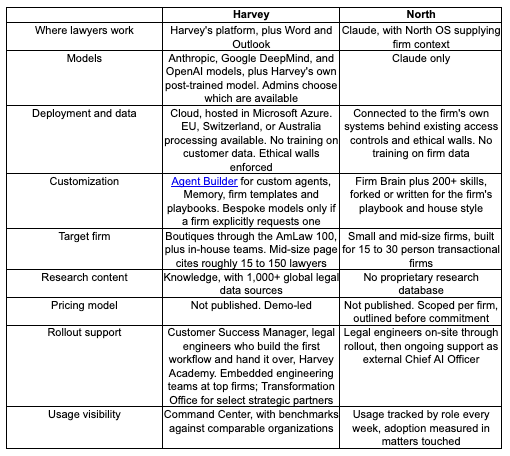
The overlap is bigger than either company's marketing suggests. On the basics of enterprise-grade legal AI, both keep client data out of model training, cite sources, put legal engineers on a firm's workflows, and measure usage. If any vendor, us included, calls one of those unique, ask to see it.
Three differences hold up. The first is model philosophy. Harvey offers model choice, arguing that several providers give better results and protect against any one provider's disruption. We go deep on one model family: every skill we build runs on Claude, and lawyers work in Claude itself. Both approaches pick up new models quickly: Harvey announced Opus 5 inside its platform on July 24, 2026, the same day Anthropic released it.
The second is what happens after the first workflow, on Harvey's mid-size offer. There, Harvey's legal engineers hand the first workflow to the firm to run, with customer success support well past go-live. At small and mid-size firms, our engineers keep building custom skills and tools after launch.
The third is scope. Harvey covers research, litigation, in-house contracting, and client collaboration. We focus on transactional work at small and mid-size firms, with no research library.
AI wrapper vs. custom legal AI: what's the difference?
"Wrapper" usually means a product whose value is an interface and a set of prompts sitting over a model someone else controls. An engineered system is a model connected to the firm's own records, encoding the firm's positions, and maintained by people who answer for whether lawyers use it.
The label matters less than it sounds. Harvey post-trains models and builds agents, so it doesn't fit the thin-wrapper caricature. The useful question is which parts are specific to your firm, and who keeps them working after the demo.
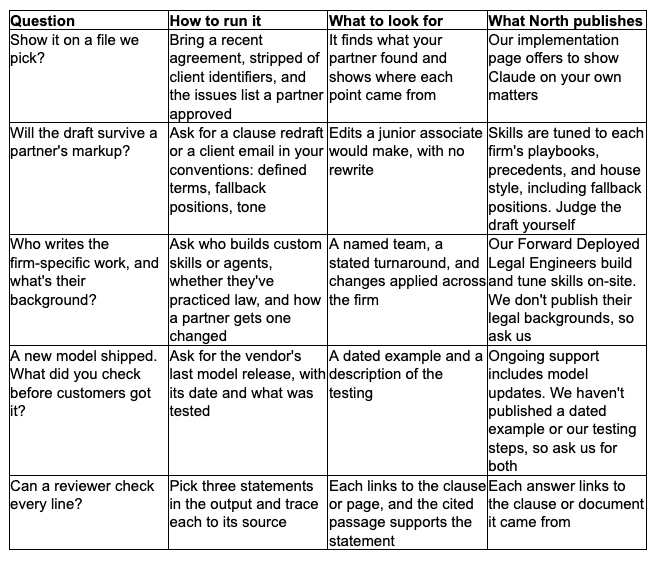
Ask every vendor on your list these five questions, us included. The last column shows what North publishes. Where we haven't published an answer, ask us on the call and hold us to the same standard.
Which firm is each built for?
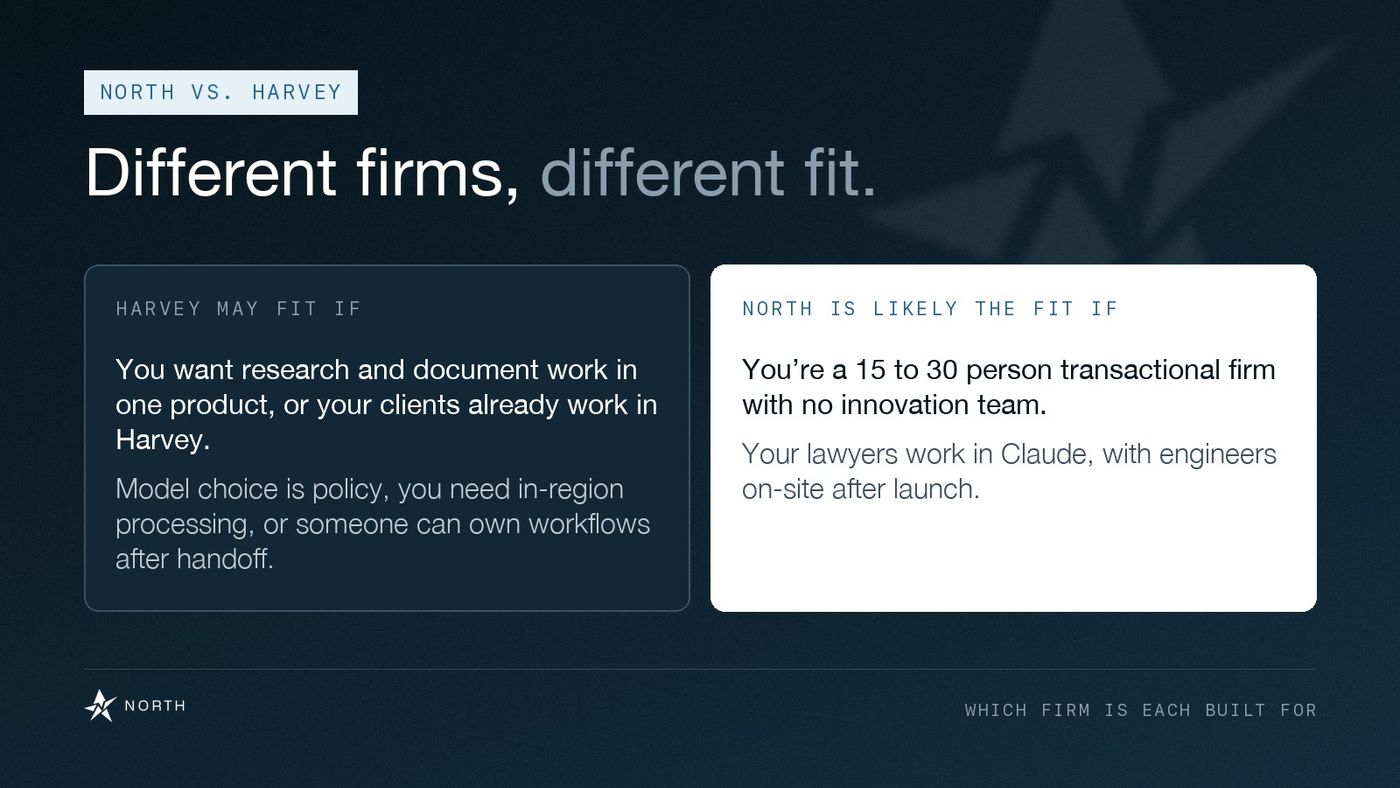
Harvey may suit your firm better if:
- You want research and document work in one product. Harvey's law firm page cites more than 1,000 global legal data sources, and its October release added a motion-to-dismiss workflow researched against LexisNexis case law.
- Your clients already work in Harvey. The same page says more than 1,000 in-house legal departments are on Harvey, and Spaces lets firms and clients share a matter workspace.
- Model choice is a policy requirement. Administrators choose which models are available, and Harvey says it can disable a specific provider at a firm's request.
- You need in-region processing in the EU, Switzerland, or Australia.
- Someone at your firm can own workflows after handoff, backed by Harvey's self-paced Academy training.
If you're comparing AI for transactional law firms of 15 to 30 people with no innovation team, and your partners want to work in Claude, North is likely the better fit. Your hours go to diligence, leases, closings, and NDAs, where skills like Tabular Review, Lease Abstraction, Closing Checklist, and NDA Review do their work. And you want engineers in the building while habits form.
Firms in between, such as a 60-lawyer firm with a busy litigation group, could reasonably shortlist both.
Running a Harvey alternative comparison at your firm
Treat a "Harvey alternative" search as the start of an evaluation:
- Pick one workflow that costs real hours, such as a diligence grid.
- Put the five questions to each vendor in writing, on the same file.
- Ask each for a reference firm close to your size and practice mix.
- Since neither publishes pricing, ask each quote to separate licenses, implementation, and ongoing support.
How to Choose a Claude Implementation Partner for Your Law Firm covers what outside help involves, and our guide to firm-wide AI implementation covers the rollout. For another matchup, see North vs. Eudia.
Frequently asked questions
What are good alternatives to Harvey AI for a mid-size law firm?
Legora positions itself as an agent-based legal platform with a scope close to Harvey's. Firms whose main need is research can compare CoCounsel Legal and Lexis+ with Protégé. Firms that want Claude engineered into their own systems, with engineers on-site, look at North.
What models does Harvey use?
As of November 2026, Harvey uses models from Anthropic, Google DeepMind, and OpenAI, along with its own post-trained open-weight model. Recent additions include Claude Opus 5, Fable 5.1, and GPT-6 Astra. Administrators control which models their firm can use.
Is North a Harvey alternative for transactional firms?
For a 15 to 30 person transactional firm without an innovation team, yes. Lawyers work in Claude, connected to the firm's documents and matters, with skills for diligence, leases, closings, and NDAs. If you also need a research library or a shared client workspace, weigh Harvey carefully.
Ask us the five questions
Take the table above into a 30-minute call with North and ask us every row, including the two we haven't published. We'll work from your own matters as the examples, and you can put Harvey's answers next to ours.
Sources: Harvey, Harvey Raises $550M at a $15.5B Valuation to Help Legal Teams Own Their Intelligence, September 9, 2026; Harvey, Why Harvey Is Multi-Model by Design, March 10, 2026; Harvey, Claude Opus 5, Now Live in Harvey, July 24, 2026; Harvey, The Brief: October 2026; Harvey, homepage (accessed November 5, 2026); Harvey, Legal AI for Mid-Sized and Small Firms (accessed November 5, 2026); Harvey, AI for Law Firms (accessed November 5, 2026); Harvey, Security (accessed November 5, 2026); Harvey, Introducing Harvey's Transformation Office, May 4, 2026; Harvey, Harvey Raises Growth Round at $11 Billion Valuation, March 25, 2026; Harvey, Introducing Agent Builder, March 9, 2026; Harvey, Run Custom Harvey Agents Directly in Word, September 23, 2026; Harvey, The New Harvey for Outlook, August 12, 2026; Anthropic, Introducing Claude Opus 5, July 24, 2026; Legora, $550M Series E, October 21, 2026; Thomson Reuters, CoCounsel Legal (accessed November 5, 2026); LexisNexis, Lexis+ with Protégé (accessed November 5, 2026)