

AI for small law firms pays off when the rollout fits the firm, not Big Law. Pick one or two recurring workflows, set rules before client data goes in, give someone ownership of setup and adoption, and measure total time saved. That holds for a 20-lawyer boutique and a 100-person mid-sized firm alike.
At a 20-person transactional firm, the partner deciding whether to adopt AI is often the same partner reviewing tomorrow's NDA. At an 80-person firm, that partner might have a practice group to lead as well. Either way, the decision sits close to the work, and there's very little time to test anything new.
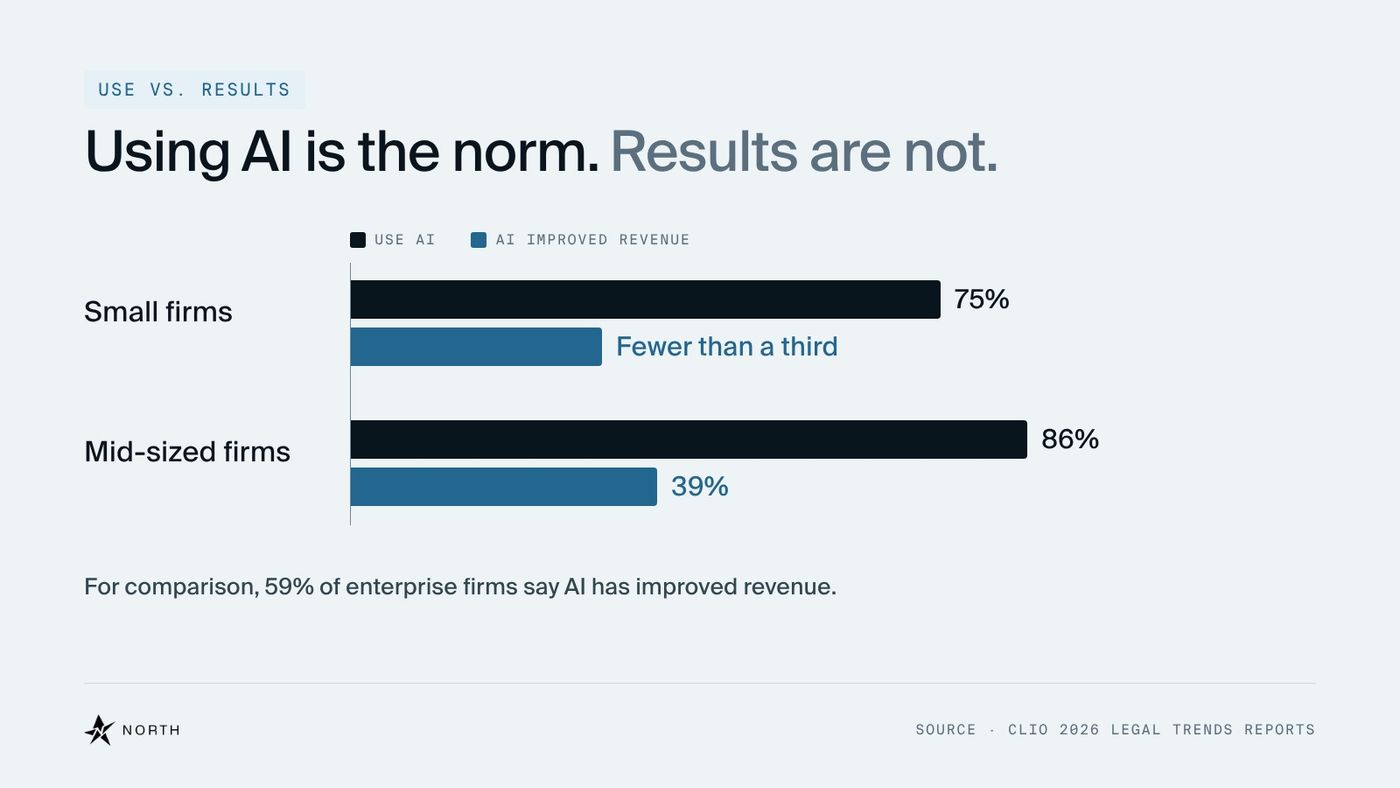
Almost everyone is trying. Clio's 2026 research found that 75% of small firms and 86% of mid-sized firms now use AI. Far fewer are getting paid for it: AI has improved revenue at fewer than a third of small firms and 39% of mid-sized firms, against 59% of enterprise firms.
Using AI is now the norm. Getting results from it is not. The gap comes down to how firms roll it out, and the playbook that works at Big Law is usually the wrong one to copy.
What does Big Law's AI playbook look like?
In April 2026, Freshfields rolled Claude out to 5,700 people across 33 offices, built on its own in-house platform, under a multi-year co-development agreement with Anthropic. Usage rose roughly 500% in the first six weeks. Years earlier, Allen & Overy's Harvey trial put about 3,500 lawyers through some 40,000 queries before a firmwide launch.
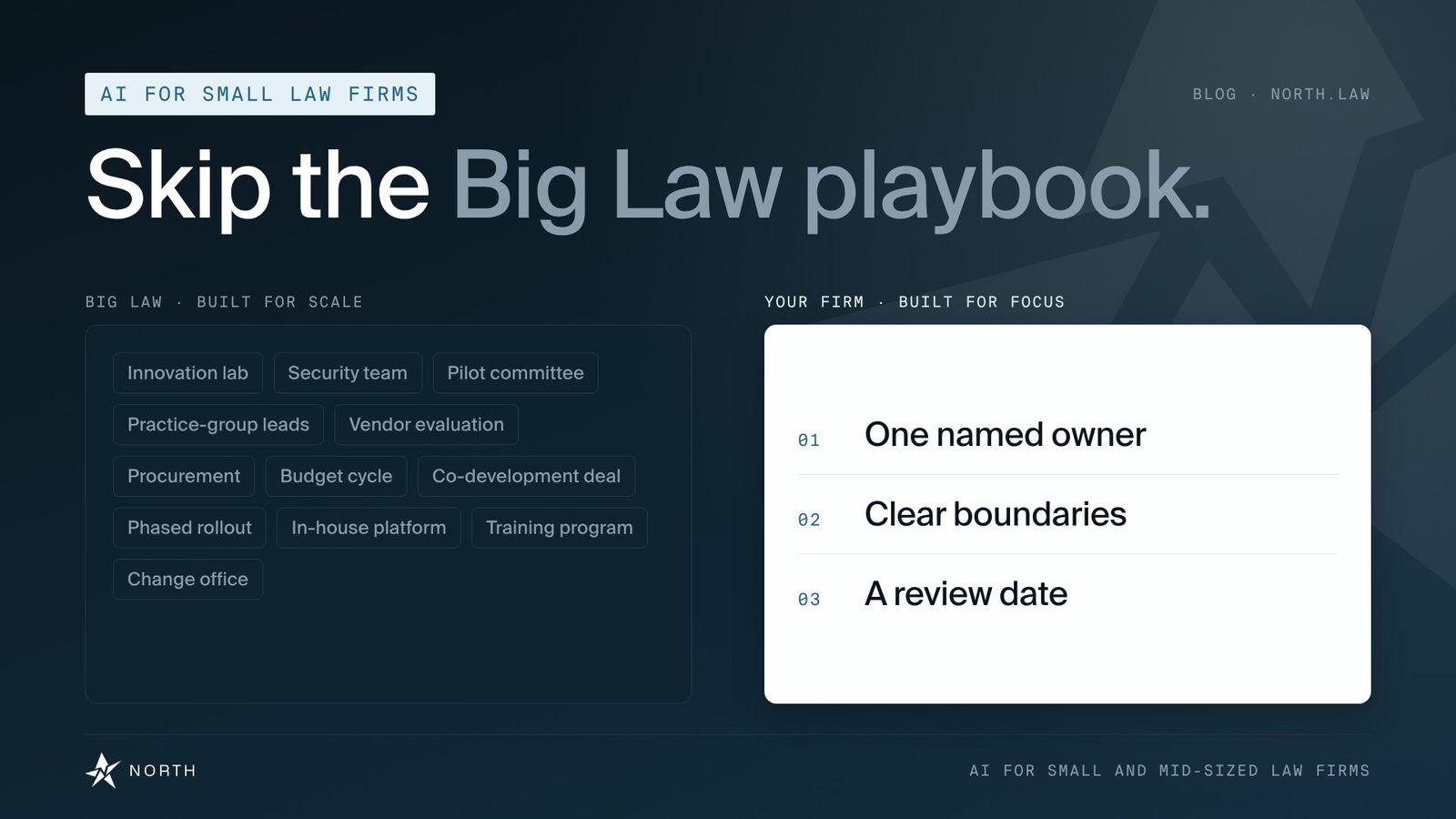
Big firms can move fast. But they move fast with an innovation lab, a security team, practice-group leaders, and a budget for all three. The lesson isn't the org chart. It's that rollouts work when the use case, the owner, and the controls are clear.
Why doesn't that playbook fit a smaller firm?
A 20- or 80-person firm usually doesn't have an innovation team. It has partners and, maybe, outside IT. The lawyer running the pilot also has a full matter list, so testing competes with client work.
The data backs this up. Time is the biggest technology-adoption barrier for 33% of small firms. At mid-sized firms, the leading obstacle is integrating new tools into existing workflows, cited by 30%. Interest isn't the problem. Capacity is.
So skip the elaborate approval process. Give one pilot a named owner, clear boundaries, and a review date. Confidentiality, client requirements, and output review still matter. They just don't need a committee.
What advantages do smaller firms have?
Proximity. One accountable partner can sponsor a pilot and hear directly from the lawyers using it. Problems reach the person who can fix them without passing through layers.
Shared work. If several lawyers work from the same NDA playbook, that workflow is a ready-made test. Compare the output against the firm's approved positions and record where the tool helps, misses, or adds review time.
Direct communication. A small team can talk through a change in one room. That makes the briefing easy. Training, feedback, and follow-through decide whether it sticks in a busy week.
Mid-sized firms are already showing what that looks like. Clio found that 65% of mid-sized firms handle higher work volumes because of AI, and 42% say it sets them apart from competitors, roughly double the rate among smaller practices.
Where do smaller firms leave value on the table?
Generic tools. Clio reports that most solo and small firms rely on general-purpose AI rather than tools built for legal work. Those tools need constant re-prompting, lack the firm's context, and raise confidentiality questions when client details go in.
No rules. 55% of small firms operate without an AI policy, while 60% of mid-sized firms have a formal one. And in an 8am survey of more than 1,300 legal professionals, only 9% reported a written AI policy that's actually enforced.
No training. In 8am's 2026 Legal Industry Report, 53% of small firms said they haven't provided AI training and have no plans to. Individual use of general-purpose AI (68%) runs well ahead of firmwide use (45%), so what one lawyer learns rarely reaches the rest of the firm. That's the gap Claude training for law firms is meant to close.
Unchanged pricing. 78% of small firms haven't adjusted pricing in response to AI. If AI cuts a task from three hours to one and the firm bills hourly, the savings go to the client.
What is the risk of waiting?
Early pilots teach a firm things it can't learn any other way: where its templates break, which errors recur, how much review a given task really needs. Waiting postpones those lessons. It isn't fatal; later adopters can borrow outside expertise and newer tools. But clients are already asking about turnaround, and an answer grounded in a tested workflow beats one grounded in a demo.
What does Claude implementation look like at a smaller firm?
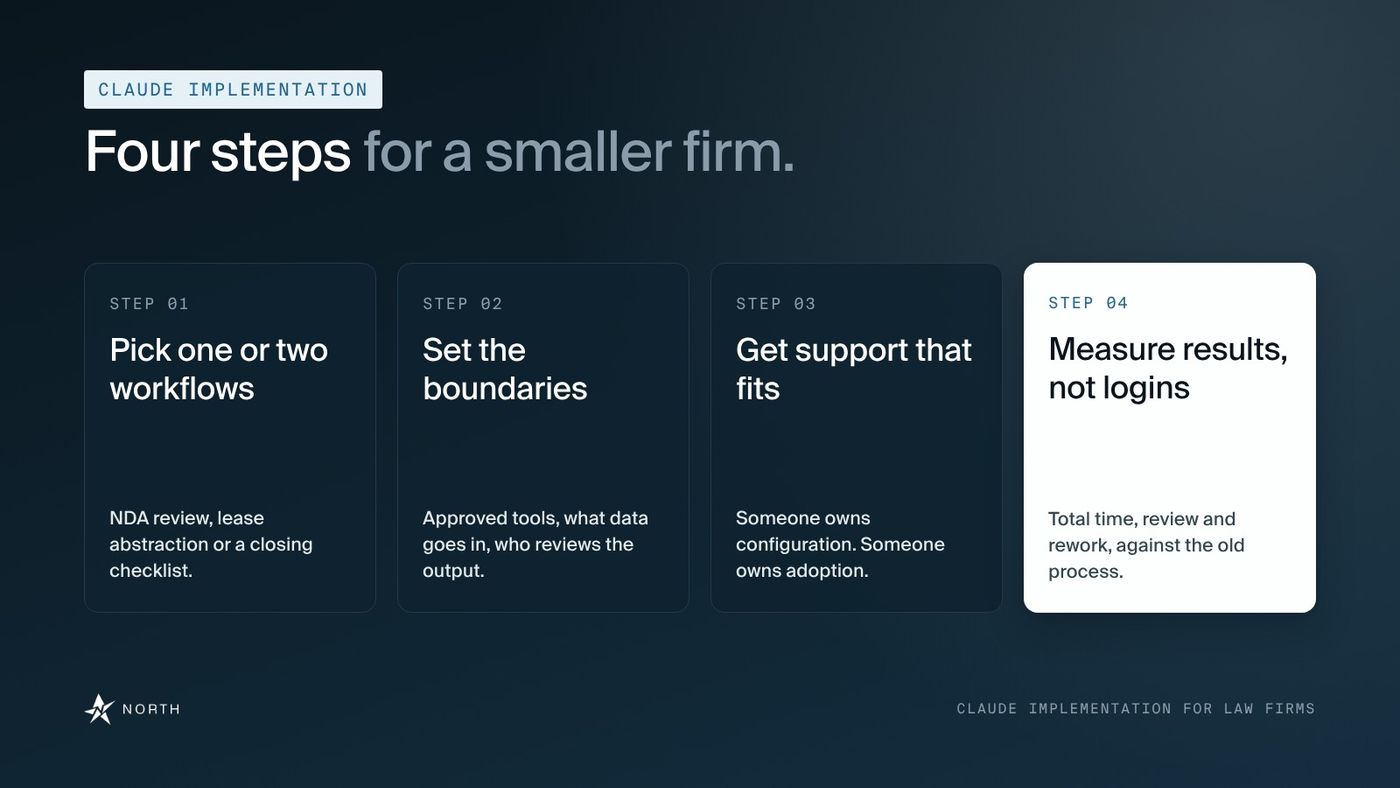
1. Pick one or two recurring workflows
Start where the firm has plenty of examples and a clear picture of a good result: NDA review, lease abstraction, or a closing checklist. An infrequent but high-stakes task can work too, if you can test it against past matters.
2. Set the boundaries before client data goes in
Decide which tools are approved, what data they can receive, who has access, and who reviews output. ABA Formal Opinion 512 frames the core duties: competence, confidentiality, client communication, and reasonable fees. Check your state rules and client obligations too.
Firms are doing this in the right order. When Hanson Bridgett, an AmLaw 200 firm, launched Claude in June 2026, it put a written use policy, limits on what information goes in, and an ongoing review process in place first.
3. Get support that fits the team
North's Forward Deployed Legal Engineers work on-site, building your templates and working practices into Claude and training your lawyers to use it. Internal or remote support can work too. Whichever route you take, Claude implementation for law firms comes down to two jobs. What matters is that someone owns configuration and someone owns adoption. We cover the second half in How Do You Actually Get Lawyers to Use AI?.
4. Measure results, not logins
Seat counts show access. Logins show activity. Neither proves a workflow improved, which is the gap between tool access and adoption. Yet only 18% of organizations collect ROI metrics on AI, according to Thomson Reuters. Compare total time, including review and rework, against the old process. Track errors and client outcomes. That gives the managing partner evidence to continue, change, or stop.
Frequently asked questions
Is AI worth it for a small law firm?
It can be, when a defined workflow delivers measurable benefits after subscription, setup, training, and review costs. High adoption rates are a reason to evaluate AI, not proof that every firm will see a return.
How is AI adoption different at small, mid-sized, and large firms?
Large firms coordinate more teams, systems, and client requirements, but usually have dedicated staff to do it. Small and mid-sized firms have fewer layers and less spare capacity. Mid-sized firms are more likely to have formal policies and report revenue gains. Neither size guarantees a faster rollout.
How should lawyers start using Claude?
Claude for lawyers works best on defined, recurring tasks with clear review steps: summarizing long documents, comparing versions, first-pass contract review. Use approved, secure access rather than a consumer account for client work, and keep a lawyer responsible for every output. For what Anthropic's legal offering includes, see Claude for Legal: What It Is and How Law Firms Actually Use It.
Where should a smaller transactional firm start?
With one or two workflows and a defined pilot. Use representative examples, set human review requirements, and compare results with the existing process before expanding.
Start with one piece of work
If your firm already has AI access, pick one task it's supposed to improve. Who uses it? What still needs correcting? How long does the whole task take now? Those answers tell you whether to fix the setup, change the tool, or expand.
Book a call with North to scope a Claude rollout around your firm's systems, workflows, and priorities.
Sources: Clio, 2026 Legal Trends Report for Solo and Small Law Firms (May 2026); Clio, 2026 Legal Trends for Mid-Sized Law Firms; 8am, 2026 Legal Industry Report (small-firm findings, August 2026); Thomson Reuters, 2026 AI in Professional Services Report, via the NC Bar (May 2026); Freshfields (April 23, 2026); Law Gazette on Allen & Overy and Harvey; Hanson Bridgett (June 1, 2026); ABA Formal Opinion 512 (July 2024).